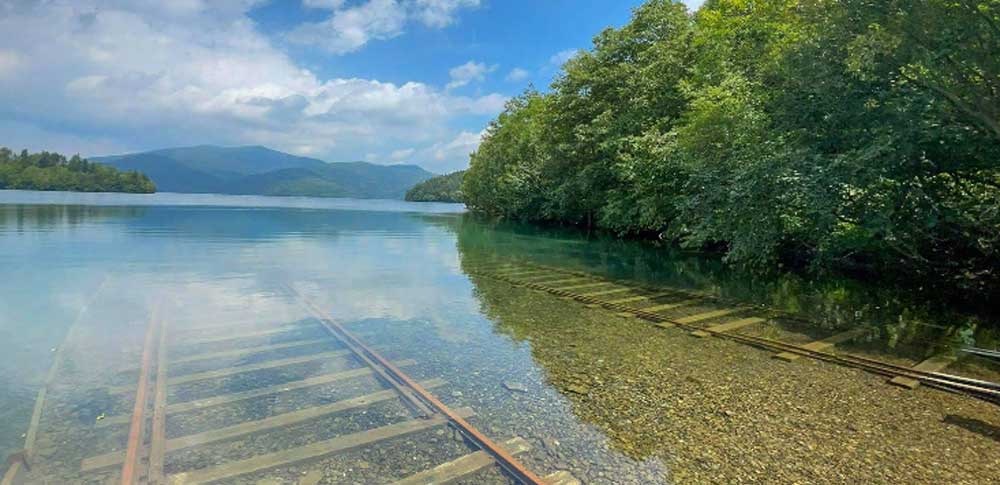
Lake Shikarisetsu (shikaribesutuko), located within Daisetsuzan National Park in Hokkaido. At the bottom of this beautiful lake lies a fantastical railway track that seems to have sprung from Studio Ghibli’s masterpiece “Spirited Away,” like the No-Face train. This article provides a detailed introduction to the full picture of this mysterious submerged lake railway.
The Lake Shikarisetsu Submerged Railway
The submerged railway at Lake Shikarisetsu is a remnant of a forest railway that was once in use. It is normally submerged, but reveals itself under specific conditions.
Basic Information
- Location: Lake Shikarisetsu Shoreline, Shikaoichō, Kamikawa District, Hokkaido
- Elevation: Approximately 810 meters
- Lake Area: Approximately 3.4 square kilometers
- Maximum Depth: Approximately 108 meters
- Formation: A dammed lake formed by volcanic activity approximately 30,000 years ago
Lake Shikarisetsu is Hokkaido’s highest natural lake and possesses a mystical atmosphere surrounded by primordial forest.
Connection to Spirited Away
Why It Reminds People of “Spirited Away”
The submerged railway evokes “Spirited Away’s” No-Face train for the following reasons:
- Railway tracks extending underwater: Similar to the film’s memorable scenes, railway tracks continue beneath the water’s surface
- An atmosphere like an entrance to another world: The tracks suddenly appearing from the lake’s surface suggest a gateway to an otherworldly realm
- Silence and mysticism: Combined with the surrounding primordial forest, it creates a spiritual atmosphere
- A landscape where time seems to have stopped: The sight of relics from the past appearing in the present overlaps with the film’s worldview
- Resemblance to the No-Face train scene: The tracks beneath the water mirror the haunting imagery of the phantom train
Not an Official Model, But…
Studio Ghibli has not officially announced that Lake Shikarisetsu served as a model. However, due to the similarity in landscape, many Ghibli fans and tourists visit as a place where they can experience the world of “Spirited Away.”
History of the Submerged Railway
The Forest Railway Era
The submerged railway at Lake Shikarisetsu is a remnant of a forest railway that was used from approximately 1939 (Showa 14) to 1962 (Showa 37).
Main Uses:
- Timber transportation
- Transport of forestry workers
- Material transport
During that time, forest railways were established throughout Hokkaido to utilize abundant forest resources. The Lake Shikarisetsu area was no exception, with tracks laid as a timber transport route from the lake shore to remote areas.
Why the Tracks Became Submerged
The tracks became submerged not due to dam construction or water level adjustments, but due to natural water level fluctuations. Lake Shikarisetsu’s water level varies due to precipitation and snowmelt, causing the tracks that once ran near the shore to become submerged.
After the forest railway was decommissioned, the tracks were not removed but left as they were, gradually becoming part of the lake over time.
When and Conditions for Viewing the Submerged Railway
Best Season
The period for viewing the submerged railway is limited:
Optimal Period: Late January to Mid-March
Reasons:
- The lake surface freezes completely in winter
- One can walk on the ice to directly above the tracks
- The tracks can be observed through the highly transparent ice
- Safe access is possible during the “Shikaribesutuko Kotan” event period
Summer Observation
During summer (June to September), the water level drops in some years, and if you’re lucky, parts of the tracks may be exposed above the water surface. However:
- Water levels differ from year to year
- The tracks are not completely visible
- Observation is limited from the lake shore
- Prior information gathering is essential
Unsuitable Periods for Observation
- April to May: High water levels due to snowmelt
- October to November: Unstable water levels due to heavy rainfall
- December to early January: Thin ice, dangerous conditions
Experiencing the Submerged Railway at Shikaribesutuko Kotan
What is Shikaribesutuko Kotan?
“Shikaribesutuko Kotan” is a winter-limited event held every year from late January to mid-March. A fantastical village using igloos (buildings made of ice blocks) appears on the frozen surface of Lake Shikarisetsu.
Operating Period: Typically late January to mid-March (varies depending on snowfall and temperature conditions)
Operating Hours: Varies by facility (generally 9:00 AM to 10:00 PM)
Admission: Basic entry is free (some facilities charge admission)
What You Can Do at Kotan
- Open-Air Bath on Ice: Enjoy an open-air bath on the frozen lake with spectacular views
- Ice Bar: Enjoy drinks at a bar made of ice
- Ice Walking: Walk above the submerged tracks with a guide
- Snowshoe Experience: Explore the surrounding snow fields
- Ice Lodge Accommodation: Experience staying in an ice hotel (reservation required)
Submerged Railway Observation Tour
During the Shikaribesutuko Kotan period, observation tours of the submerged railway led by specialist guides may be offered:
- Duration: Approximately 30 minutes to 1 hour
- Fee: Free to approximately 2,000 yen (varies by year)
- Content: Walk on ice while confirming the track location, historical explanation
- Reservations: Advance reservation recommended (participation possible at the site if space is available)
Access
By Car
From Sapporo:
- Distance: Approximately 200 kilometers
- Travel Time: Approximately 3 hours 30 minutes
- Route: Dōō Expressway → Tokachi-Shimizu IC → National Route 274 → Prefectural Route 85
From Obihiro:
- Distance: Approximately 60 kilometers
- Travel Time: Approximately 1 hour 30 minutes
- Route: National Route 236 → Prefectural Route 85
From Kushiro:
- Distance: Approximately 150 kilometers
- Travel Time: Approximately 2 hours 30 minutes
- Route: National Route 274 → Prefectural Route 85
Winter Precautions:
- Studless tires essential
- Be cautious of poor visibility due to blizzards
- Fill up with fuel in advance (few gas stations in the area)
- Keep winter gear, emergency food, and blankets in your vehicle
By Public Transportation
Bus:
- From Obihiro Station on Takushoku Bus “Lake Shikarisetsu Shore” line
- Travel Time: Approximately 1 hour 40 minutes
- Number of Runs: 2-3 buses daily (varies by season)
- Fare: Approximately 1,800 yen one-way
Note: Service may be suspended or reduced in winter, so check the Takushoku Bus website in advance.
Tour Participation
Numerous day-trip and overnight tours departing from Sapporo and Obihiro are available:
- Tours including Shikaribesutuko Kotan viewing
- Submerged railway observation tours
- Tours combined with nearby hot springs
Nearby Tourist Attractions
Lake Shikarisetsu Nature Center
A facility where you can learn about the natural environment and history of Lake Shikarisetsu.
- Reception for canoe and trekking tours
- Exhibits on the ecosystem of Lake Shikarisetsu
- Information about Dolly Varden (char fish unique to the lake)
Lake Shinonome and Lake Komadome
Other beautiful lakes are scattered around Lake Shikarisetsu:
- Lake Shinonome: Approximately 30 minutes walk from Lake Shikarisetsu, a mystical small lake
- Lake Komadome: A quiet lake surrounded by primordial forest
Shikarisetsu Gorge Hot Spring
A secret hot spring approximately 20 minutes by car from Lake Shikarisetsu:
- Natural hot spring with source water flowing continuously
- Multiple accommodations offer day-trip bathing
- The view of primordial forest from the open-air bath is spectacular
Shikaoichō Tourism
- Kanda Nissei Memorial Museum of Art: Displays works by the talented painter who died young
- Michi-no-Eki Urimaku: Sells local agricultural products and dairy products
- Tokachi Shikaoichō Geopark: Learn about landforms created by volcanic activity
Accommodations
Accommodations on Lake Shikarisetsu Shore
Fusuizu Shikarisetsuко:
- The only hotel on Lake Shikarisetsu shore
- Open-air bath overlooking the lake
- Shuttle service during Shikaribesutuko Kotan period
Lake Shikarisetsu Hot Spring Hotel:
- Equipped with natural hot spring
- Quiet lakeside environment
- Restaurant serving Hokkaido cuisine
Accommodations in Shikaoichō
Within a 30-minute drive from Lake Shikarisetsu, there are numerous minshuku and pensions. You can choose based on budget and preference.
Photography Tips
Best Shot Photography Guide
Winter (on ice) Photography:
- Time of Day: Early morning or evening with angled light is recommended
- Angle: Take photos from directly above to highlight the ice’s transparency
- Settings: Increase contrast to bring out the ice’s texture
- Equipment: Cold weather protection and extra batteries (batteries drain quickly in cold areas)
Summer (low water level) Photography:
- Time of Day: Early morning when mist rises is atmospheric
- Angle: Photograph the tracks from the shore looking down
- Composition: Combine primordial forest and tracks to create the “Spirited Away” atmosphere
Photography Precautions
- During winter, always confirm the safe walking area on ice
- Note that some lakeside areas are private property with no-entry zones
- Drone photography may require permission as it’s within a national park
- Take care to avoid damaging the environment to protect nature
Precautions and Clothing for Visits
Winter Visit Precautions
Clothing:
- Cold weather clothing (down jacket, etc.)
- Waterproof, insulated boots with non-slip soles
- Hat, gloves, scarf
- Hand warmers (multiple)
- Sunglasses (to protect against snow glare)
Items to Bring:
- Cold weather protection gear
- Smartphone and camera backup batteries
- Warm beverages (insulated bottle)
- Light snacks (for energy)
Safety Measures:
- Walk only in designated areas on ice
- Avoid traveling alone
- Act early in case of sudden weather changes
- Confirm mobile phone signal availability beforehand
Summer Visit Precautions
Clothing:
- Long sleeves and long pants (protection against insect bites)
- Trekking shoes
- Hat (sun protection)
- Rain gear (prepare for sudden rain)
Items to Bring:
- Insect repellent spray
- Sunscreen
- Drinking water
- Bear bell (protection against brown bears)
Brown Bear Precautions:
The Lake Shikarisetsu area is home to brown bears:
- Carry a bear bell
- Avoid traveling alone
- Be careful about food odors
- If encountered, quietly retreat
Environmental Protection Consideration
Lake Shikarisetsu is a valuable natural environment within Daisetsuzan National Park. When visiting, please keep the following points in mind:
- Always take trash with you: Never leave garbage to protect the natural environment
- Do not damage plants: Stay on designated trails
- Do not feed wild animals: Prevent impact on the ecosystem
- Keep your voice down: Show consideration for wildlife and other visitors
- Do not enter areas outside designated zones: Prevent danger and protect the environment
The Nature and Ecosystem of Lake Shikarisetsu
Arctic Char (Dolly Varden)
Lake Shikarisetsu is home to “Miyabe char,” a unique subspecies of Arctic char. As a glacial relict species, it is also scientifically valuable.
Characteristics:
- Body length 20-30 centimeters
- Beautiful red spots
- A unique subspecies confirmed only in Lake Shikarisetsu
- Designated as an endangered species
Surrounding Vegetation
The area around Lake Shikarisetsu is covered in primordial mixed coniferous and deciduous forest:
- Ezo spruce
- Sakhalin fir
- Erman’s birch
- Rowan
Autumn foliage is beautiful, with the best time to view being early to mid-October.
Wild Animals
Main wild animals that can be observed around Lake Shikarisetsu:
- Brown bears
- Ezo deer
- Red fox
- Ezo squirrel
- Black woodpecker (natural monument)
- White-tailed sea eagle
Frequently Asked Questions
Q: Can the submerged railway be seen year-round?
A: No. The most reliable time to observe it is during winter (late January to mid-March) when the lake is frozen. In summer, there is only a possibility of partial visibility in years when water levels drop.
Q: Is it safe to walk on the ice individually?
A: It is safe to walk in designated areas during the Shikaribesutuko Kotan period. At other times and locations, it is dangerous, so be sure to participate in a guided tour.
Q: Can I make a day trip from Sapporo?
A: It is possible, but since it takes approximately 3 hours 30 minutes one-way, an early departure is necessary. In winter, there is also a risk of road closures due to weather, so plan with adequate time.
Q: Is it really the model for “Spirited Away”?
A: Studio Ghibli has not officially acknowledged it as a model. However, because the landscape of tracks continuing underwater evokes the scene of the No-Face train in the film, among fans it is popular as a place where you can “experience the world of Ghibli.”
Q: Are there other attractions besides the submerged railway?
A: Lake Shikarisetsu itself is a beautiful natural lake, and the surrounding area has numerous attractions including trekking courses, hot springs, and wildlife observation spots. Each season offers different charms.
Summary
The submerged railway at Lake Shikarisetsu is a historical relic sleeping in Hokkaido’s great nature and a mystical spot where you can experience the world of “Spirited Away.”
Key Points for Visiting:
- Best Season: Late January to mid-March (Shikaribesutuko Kotan period)
- Access: Car is convenient (studless tires essential in winter)
- Travel Time: Approximately 3 hours 30 minutes one-way from Sapporo
- Clothing: Cold weather and insect protection appropriate to the season
- Precautions: Do not forget environmental protection and brown bear precautions
The experience of walking on the frozen lake in winter and observing the submerged tracks beneath the ice will bring a sense of wonder akin to opening a door to another world. Recommended not only for Ghibli fans, but also for nature enthusiasts and photography enthusiasts.
When visiting Hokkaido, be sure to visit Lake Shikarisetsu’s submerged railway and experience this fantastical world.