
Amanoishitatejinja Shrine (天之石立神社) and the Ittouishi stone located deep within its precincts in Yagyu Town, Nara City, Nara Prefecture, have recently garnered significant attention as a sacred site for the popular anime “Demon Slayer: Kimetsu no Yaiba.” The legends of tengu and swordsmen remaining in Yagyu, known as the land of master swordsmen, and the mystery of the massive boulder split cleanly in two continue to captivate countless pilgrims.
This article comprehensively explains everything necessary for a visit, from the historical background of Ittouishi and Amanoishitatejinja Shrine, to detailed access methods, connections to Demon Slayer: Kimetsu no Yaiba, and nearby tourist attractions.
Ittouishi | A Legend Carved into a Boulder Approximately 7 Meters in Size
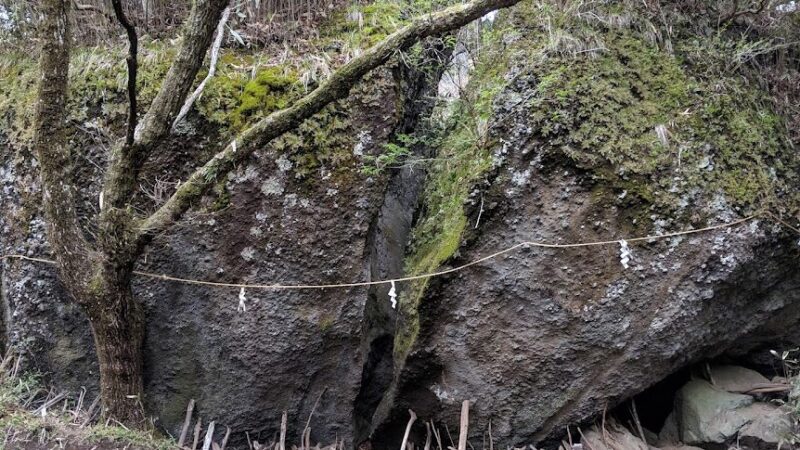
Ittouishi is a granite boulder measuring approximately 7 meters square, located deep within the Amanoishitatejinja Shrine precincts in a mountain area called Toiwani. Its most distinctive feature is the spectacular sight of this massive rock split vertically down the middle.
The Legend of Yagyu Sekishuusai and the Tengu
A famous legend surrounds Ittouishi, connected to Yagyu Muneyo shi (known as Sekishuusai), the founder of the Yagyu Shinkage-ryuu school of sword techniques.
Sekishuusai practiced swordsmanship for three years within the precincts of Amanoishitatejinja Shrine. One night, a tengu appeared before him and challenged him to a sword match. At the moment when Sekishuusai thought he had cut down the tengu with a powerful stroke, the tengu’s form vanished, and the massive boulder at that spot had been split perfectly in two. This is the tale that has been passed down through generations.
This legend has been transmitted as a story symbolizing the extraordinary sword techniques of Sekishuusai and the essence of Yagyu Shinkage-ryuu. While it is actually believed to have been split by natural weathering, the perfection of the split has lent credibility to the legend.
Physical Characteristics of Ittouishi
Ittouishi is composed of granite, with a height of approximately 7 meters and a width of approximately 7 meters as well. The fissure runs vertically, with a width of several dozen centimeters. The sharp cut, as though made by a colossal sword stroke, remains clearly visible even after centuries have passed.
Moss grows on the rock’s surface, and combined with the surrounding trees, it creates a mystical atmosphere. Particularly at dawn or dusk, dappled sunlight illuminating the fissure creates a fantastical landscape.
The History and Background of Amanoishitatejinja Shrine
Amanoishitatejinja Shrine is an ancient shrine that designates the location where Ittouishi stands as sacred ground. While its official founding date is unknown, it has long been revered as an object of massive rock worship.
The Shrine’s Enshrine d Deity and Beliefs
The enshrined deity of Amanoishitatejinja Shrine is said to be Amaterasu Oomikami. The shrine name “Amanoishitate” is said to derive either from the legend of Ama no Iwato, or from the massive boulders strewn throughout this area.
Numerous other massive rocks are scattered throughout the shrine precincts, leaving strong remnants of ancient iwakura (sacred rock) worship. These boulder groups were selected as a scenic site called “Manen Gorge,” one of “Ten Views of Yagyu,” by the eminent Buddhist monk Takuan Soho during the Edo period.
The Shrine Building and Precincts
While modest in scale, Amanoishitatejinja Shrine’s main hall is a charming structure. Proceeding past the worship hall and further along the mountain path leads to a path to Ittouishi.
The precincts are surrounded by natural forest, displaying fresh greenery in spring and beautiful autumn leaves in fall, showing varied beauty throughout the seasons. Stone steps covered in moss and massive rocks are arranged along the path, creating a sacred atmosphere.
Connection to Demon Slayer: Kimetsu no Yaiba | A Sacred Site for Pilgrimage
Ittouishi has gained attention as a sacred site for “Demon Slayer: Kimetsu no Yaiba” primarily due to similarities with the protagonist Tanjirou Kamado’s training scenes.
Similarities with Tanjirou’s Rock-Cutting Training
In Episode 3 of “Demon Slayer: Kimetsu no Yaiba,” Tanjirou undergoes grueling training under his instructor Sakonji Urokodaki, attempting to split a massive boulder in two with his Nichirin sword. This rock-cutting training was a condition for participating in the Final Selection of the Demon Slayer Corps.
The sight of Ittouishi is precisely that of the rock Tanjirou cut in the training scene. A massive boulder split vertically in two, a mystical atmosphere in the mountains, and legends related to sword training—there are many points in common.
Possibility of Being a Creative Reference
While there has been no official announcement that author Gotouge Koyoharu directly referenced Ittouishi, it is clear that elements from Japan’s sword techniques history and legends have been incorporated into the work. The Yagyu Shinkage-ryuu and Sekishuusai’s legend are extremely famous in Japanese sword technique history, and it is entirely plausible that they had some influence during the work’s creation process.
The Current State as a Sacred Site
Due to the popularity of Demon Slayer: Kimetsu no Yaiba, many fans have begun visiting Ittouishi. On-site photography staging has been set up, and props such as bamboo swords are provided, allowing visitors to recreate famous scenes from the work in photographs.
On weekends and holidays, many pilgrims visit, and waiting lines sometimes form. Enjoy the experience while respecting manners and showing consideration for other visitors.
The History of Yagyu Village and Yagyu Shinkage-ryuu
Understanding Yagyu as a place and the history of Yagyu Shinkage-ryuu is important for understanding Ittouishi.
The Establishment of Yagyu Shinkage-ryuu
Yagyu Shinkage-ryuu is a school of sword technique established and perfected by Yagyu Muneyo shi (Sekishuusai) from the late Sengoku period through the early Edo period. Sekishuusai learned Shinkage-ryuu from Kamiizumi Nobutsuna and created Yagyu Shinkage-ryuu by adding his own innovations.
The characteristic of Yagyu Shinkage-ryuu lies in the philosophy of “katsunin-ken” (life-giving sword). This is not merely a sword for defeating opponents, but rather embodies the ideal of a sword that keeps opponents alive while keeping oneself alive. This philosophy later became a factor in adoption as the martial arts instructor to the Tokugawa shogun family.
The Yagyu Clan and the Tokugawa Shogunate
Sekishuusai’s son, Yagyu Munenori, served Tokugawa Ieyasu and became the shogun family’s sword technique instructor. His son, Yagyu Juubee Mitsuyoshi, also became renowned as a master swordsman, and the Yagyu clan maintained a deep relationship with the shogunate throughout the Edo period.
The Yagyu village contains numerous historical sites connected to the Yagyu clan, with Ittouishi being one of the most symbolic locations among them.
Yagyu as a Village of Master Swordsmen
The present-day Yagyu Town is a small settlement of approximately 1,000 residents, but has been developed as a tourist destination known as the “Village of Master Swordsmen.” Historical sites related to the Yagyu clan, such as the Yagyu Clan Family Elder’s Mansion, the Masaki-zaka Sword-Zen Training Hall, and Juubee Cedar, are scattered throughout, making it a sacred destination for history enthusiasts and martial arts lovers.
Detailed Access Information | Public Transportation and Private Vehicle
Access to Ittouishi and Amanoishitatejinja Shrine is by public transportation or private vehicle. Because it is located in a mountainous area, advance planning is important.
Access by Public Transportation
Bus from JR Nara Station or Kintetsu Nara Station
- Board Nara Kotsu bus toward “Yagyu/Muji Nakamura”
- Board from Bus Stop 1 on the east side of JR Nara Station
- Board from Bus Stop 21 at Kintetsu Nara Station
- Travel time: Approximately 50 minutes
- Fare: 770 yen one way (as of 2024)
- Disembark at “Yagyu” bus stop
- This is one of the final stops
- Walk from bus stop to Ittouishi
- Travel time: Approximately 20–25 minutes
- Distance: Approximately 1.5 km
- Walking shoes are essential as the route includes mountain paths
Bus Operation Frequency
Bus operation is limited to several buses per day. Schedules differ between holiday and weekday timetables, so be sure to check the latest schedule on the Nara Kotsu official website. Also check the return bus time in advance to avoid missing it.
Access by Private Vehicle
From Osaka
- Approximately 30 minutes from “Hourai IC” on the Second Hanwa Expressway via Route 369
- Approximately 50 minutes from “Horyuji IC” on the Hanshin Expressway via Routes 25, 308, and 369
From Kyoto
- Approximately 40 minutes from “Kizu IC” on the Kyoto-Nara-Wakayama Expressway via Routes 163 and 369
From Nagoya
- Approximately 30 minutes from “Hari IC” on the Meishin Expressway via Route 369
Parking Information
The nearest parking area to Ittouishi is “Yagyu Tourism Parking Area.”
- Location: Near 155-1 Yagyu-machi, Nara City
- Fee: Free
- Capacity: Approximately 20 vehicles
- Hours: Available 24 hours
- Distance to Ittouishi: Approximately 15–20 minutes on foot
Parking may be full on holidays and extended holidays. Early arrival is recommended. Also, as roads are narrow mountain paths, visiting in large vehicles is not advisable.
Walking Route to Ittouishi
From the parking area or bus stop to Ittouishi, proceed via the following route:
- Pass through the Yagyu village settlement
- Enter the mountain path following directional signs
- Pass through the torii gate of Amanoishitatejinja Shrine
- Proceed along the path to the worship hall
- From beside the worship hall, proceed into the mountain path further back (approximately 5 minutes)
- Arrive at Ittouishi
Directional signs are installed along the way, but some sections of the mountain path have unstable footing. Particular caution is needed in wet weather or after rain, as surfaces become slippery.
Precautions and Etiquette When Visiting
Keep the following points in mind when visiting Ittouishi and Amanoishitatejinja Shrine.
Clothing and Items to Bring
- Walking shoes: Sneakers or hiking boots are recommended. Heels and sandals are not suitable
- Comfortable clothing: Wear clothes that allow easy movement for walking mountain paths
- Seasonal precautions: Insect repellent in summer, winter clothing in cold seasons
- Beverages: Bring your own as vending machines are limited
- Rain gear: A folding umbrella or rain coat is helpful as weather can change suddenly
Shrine Visit Etiquette
- The shrine is a sacred place: Amanoishitatejinja Shrine is both a tourist destination and a place of worship
- Worship at the worship hall: Pay your respects at the worship hall before heading to Ittouishi
- Photography etiquette: Be considerate of other worshippers
- Keep conversations quiet: Maintain a quiet environment
- Take trash with you: Please cooperate in protecting the natural environment
Safety Precautions
- Watch your footing: There are rocks and stairs; there is risk of falling
- Check the weather: Avoid visiting during heavy rain or typhoons
- Heat stroke prevention: Drink water frequently in summer
- Check sunset time: Mountain paths become dark after sunset. Descend before dark
Nearby Tourist Attractions | Touring Yagyu Village
Once you’ve visited Ittouishi, explore other historical sites in Yagyu village.
Yagyu Clan Family Elder’s Mansion
The residence of the family elder who served the Yagyu clan, a valuable building that conveys the style of samurai residences of the Edo period. The interior is open as a museum where you can view exhibits related to the history of the Yagyu clan and Yagyu Shinkage-ryuu.
- Opening hours: 9:00 AM–5:00 PM
- Closed: Year-end and New Year holidays
- Admission: Adults 350 yen, Middle and high school students 200 yen, Elementary school students 100 yen
- Time needed: Approximately 30 minutes
Masaki-zaka Sword-Zen Training Hall
A training hall site allegedly built by Yagyu Munenori representing the unity of sword and Zen. Currently only a monument remains, but it is worth visiting as a place where one can sense the spirituality of Yagyu Shinkage-ryuu.
Juubee Cedar
A massive cedar tree said to have been planted by Yagyu Juubee Mitsuyoshi. You can see its impressive form, approximately 400 years old and about 30 meters tall. Near Juubee Cedar stands Houkokuji Temple, which houses the Yagyu clan’s burial site.
Houkokuji Temple
The Yagyu clan’s family temple, containing the graves of Yagyu Muneyo shi (Sekishuusai) and other members of the Yagyu clan. The temple grounds also display materials related to Yagyu Shinkage-ryuu, allowing you to gain deeper knowledge of Yagyu’s history.
- Visitation hours: 9:00 AM–5:00 PM
- Visitation fee: Adults 300 yen, Middle and high school students 200 yen, Elementary school students 100 yen
Yagyu Camp Remains
The site of the Yagyu clan’s administrative office, where stone walls and parts of gates remain today. Plum blossoms bloom beautifully in spring, making it a popular photography spot.
Dining and Souvenirs in Yagyu Village
Yagyu village offers dining options using local ingredients and souvenirs unique to Yagyu.
Recommended Dining Establishments
Dining Hall Near Former Yagyu Camp Remains
A dining hall serving set meals using local vegetables and Nara specialty items such as persimmon leaf sushi. You can enjoy simple yet warm-hearted cuisine.
Yagyu Village Café
A café in a renovated traditional house offering coffee, light meals, and sweets. Perfect for taking a break during your tour.
Souvenirs
Ittouishi Ice Cream
Ice cream with the Ittouishi as its motif, garnering attention for its high level of accuracy. The rock’s texture is expressed in chocolate with a fissure down the center. It can be purchased at souvenir shops in Yagyu village.
Yagyu-Related Merchandise
Merchandise such as hand towels, T-shirts, and wooden swords featuring Yagyu Shinkage-ryuu and the Yagyu clan are sold. Shops also carry Demon Slayer: Kimetsu no Yaiba-related merchandise.
The Charm of Ittouishi Through the Seasons
Ittouishi displays a different face with each season.
Spring (March–May)
Fresh greenery is beautiful, with trees budding along the path. The temperate climate makes this an easy season to visit. During cherry blossom season, Yagyu village becomes vibrant.
Summer (June–August)
Surrounded by deep green, the shade provides cool relief. However, temperatures are high and insects are numerous, requiring precautions. Early morning visits are recommended.
Autumn (September–November)
Fall foliage season is when the area around Ittouishi is most beautiful. The contrast between trees colored red and yellow and the massive boulder is spectacular. Mid- to late November is peak foliage season.
Winter (December–February)
When there is snowfall, Ittouishi wears a snow-white mantle, creating a fantastical sight. However, there is potential for icy road surfaces, requiring careful attention when visiting.
Model Courses for Visiting Ittouishi
We introduce model courses for efficiently touring Yagyu village.
Half-Day Course (approximately 3–4 hours)
- Arrive at Yagyu Tourism Parking Area (9:00 AM)
- Amanoishitatejinja Shrine and Ittouishi (9:15 AM–10:15 AM, including walking, prayer, and photography)
- Yagyu Clan Family Elder’s Mansion (10:30 AM–11:00 AM)
- Lunch (11:15 AM–12:15 PM)
- Houkokuji Temple (12:30 PM–1:00 PM)
- Return to Yagyu Tourism Parking Area (1:15 PM)
Full-Day Course (approximately 6–7 hours)
- Arrive at Yagyu Tourism Parking Area (9:00 AM)
- Amanoishitatejinja Shrine and Ittouishi (9:15 AM–10:30 AM)
- Masaki-zaka Sword-Zen Training Hall (10:45 AM–11:00 AM)
- Yagyu Clan Family Elder’s Mansion (11:15 AM–12:00 PM)
- Lunch (12:15 PM–1:15 PM)
- Houkokuji Temple (1:30 PM–2:15 PM)
- Juubee Cedar (2:30 PM–2:45 PM)
- Yagyu Camp Remains (3:00 PM–3:30 PM)
- Souvenir Shopping (3:45 PM–4:00 PM)
- Return to Yagyu Tourism Parking Area (4:15 PM)
Photography Techniques for Ittouishi
We introduce tips for taking memorable photographs at Ittouishi.
Recommended Photography Angles
Frontal Photography
The angle where the Ittouishi’s fissure is most visible. You can capture both the entire stone and the sharpness of the split.
Diagonal Photography
This angle captures both the three-dimensionality of the rock and the surrounding forest atmosphere. Photos taken when light filters through are particularly beautiful.
Fissure Close-up
This emphasizes the sharp quality of the fissure and the texture of the moss-covered rock surface.
Optimal Times for Photography
- Early morning (7:00 AM–9:00 AM): Few people around, with morning sunlight creating dappled light for a fantastical atmosphere
- Forenoon (9:00 AM–11:00 AM): Good lighting conditions suitable for photography
- Late afternoon (4:00 PM–5:00 PM): Evening light creates warm-toned photographs
Demon Slayer: Kimetsu no Yaiba-Style Photography
To recreate the work’s atmosphere, holding a bamboo sword and striking poses is recommended. Use the props provided on-site. Many fans are seen taking photographs wearing Tanjirou’s haori.
Frequently Asked Questions
Q: Do I need a reservation to visit Ittouishi?
A: No reservation is required. Amanoishitatejinja Shrine is open to public worship. However, if visiting as a large group, it is good to contact the Yagyu Tourism Association in advance.
Q: Is access possible with wheelchairs or strollers?
A: Unfortunately, the path to Ittouishi is a mountain trail with stairs, making wheelchair or stroller access difficult. While the path to the Amanoishitatejinja Shrine worship hall is relatively level, reaching Ittouishi requires walking.
Q: Is bringing pets allowed?
A: Pets may be brought, but they must be kept on a leash, and please be considerate of other worshippers. In particular, respect the rules at the shrine precincts.
Q: Can I visit in rainy weather?
A: Visiting is possible, but care is needed as mountain paths become slippery. During heavy rain or typhoons, visiting is not recommended due to danger.
Q: Where is the nearest restroom?
A: There is a public restroom near Yagyu Tourism Parking Area. Since there are no restrooms near Ittouishi, please use facilities beforehand.
Q: Is overnight accommodation available in Yagyu village?
A: There are several minshuku (family-run inns) in Yagyu village. Additionally, numerous hotels and inns are available if you return to central Nara. For those wishing to enjoy Yagyu at a leisurely pace, staying at a minshuku is also recommended.
Conclusion | The Charm of Ittouishi and Amanoishitatejinja Shrine
Ittouishi and Amanoishitatejinja Shrine in Yagyu, Nara Prefecture, are rare places where history, legend, nature, and contemporary pop culture intersect. The massive stone, where the legend of Yagyu Sekishuusai and the tengu lives on, attracts new attention as a sacred site for Demon Slayer: Kimetsu no Yaiba, while maintaining its ancient sacredness and mystique.
Yagyu, the village of master swordsmen, contains numerous other historical sites beyond Ittouishi that convey the history of Yagyu Shinkage-ryuu. A journey beginning with a visit to Ittouishi and exploring Yagyu’s history and culture is surely an experience that will remain in your heart.
While public transportation access is somewhat inconvenient, the sense of accomplishment and emotion felt upon visiting is all the greater for it. With a private vehicle, you can efficiently tour nearby attractions.
Whether you are a fan of Demon Slayer: Kimetsu no Yaiba, a history enthusiast, a nature lover, or interested in martial arts, Ittouishi and Amanoishitatejinja Shrine are must-see destinations. When visiting Nara, be sure to extend your trip to Yagyu village. Standing before the massive boulder split in two, you will surely feel the breath of legendary swordsmen.