
“Frieren: Beyond Journey’s End” Fantasy Landscapes: A Thorough Explanation of the Medieval European Worldview and the Appeal of Background Art
“Frieren: Beyond Journey’s End” is a manga work written by Kanehito Yamada and illustrated by Tsukasa Abe, depicting an unusual fantasy story set after the tale of the hero party that defeated the Demon King. One of the major attractions of this work is the meticulously depicted fantasy landscapes and the worldview reminiscent of medieval Europe. This article provides a thorough explanation of the fantasy landscapes in “Frieren: Beyond Journey’s End,” covering their characteristics, the appeal of background art, model locations for pilgrimages, and methods of worldbuilding.
The Worldview and Fantasy Setting of “Frieren: Beyond Journey’s End”
Work Overview and Unique Worldview
“Frieren: Beyond Journey’s End” is a manga serialized since 2020 in Weekly Shonen Sunday and published by Shogakukan. This work won the Grand Prize at “Manga Award 2021” and has received much acclaim.
The worldview of this work is a typical fantasy world where swords and magic exist, yet possesses a unique structure in that the story begins from the “end” of the adventure—the demon king’s subjugation. After the hero party consisting of the hero Himmel, the cleric Heiter, the warrior Eisen, and the mage Frieren defeats the Demon King, the story follows Frieren, an elf who lives over a thousand years, experiencing loss and reunion arising from the difference in time perception between herself and humans.
Basic Settings of the Fantasy World
The fantasy world in this work contains multiple races including humans, elves, and dwarves. Each race has different lifespans, with elves in particular living over a thousand years and dwarves living for several hundred years. This difference in lifespan becomes an important theme of the story.
Magic is a crucial element in this world, with diverse magic appearing from offensive spells to practical magic that makes everyday life convenient. Frieren’s hobby is collecting magic, and various spells are introduced throughout the work. Demons are depicted as entities with different values from humans, appearing as beings who use human language yet are fundamentally unable to understand one another. Encounters with demons remaining in various places after the Demon King’s death become important elements of the story.
Medieval European-Style Landscape Depictions
Stone Architecture and Cityscapes
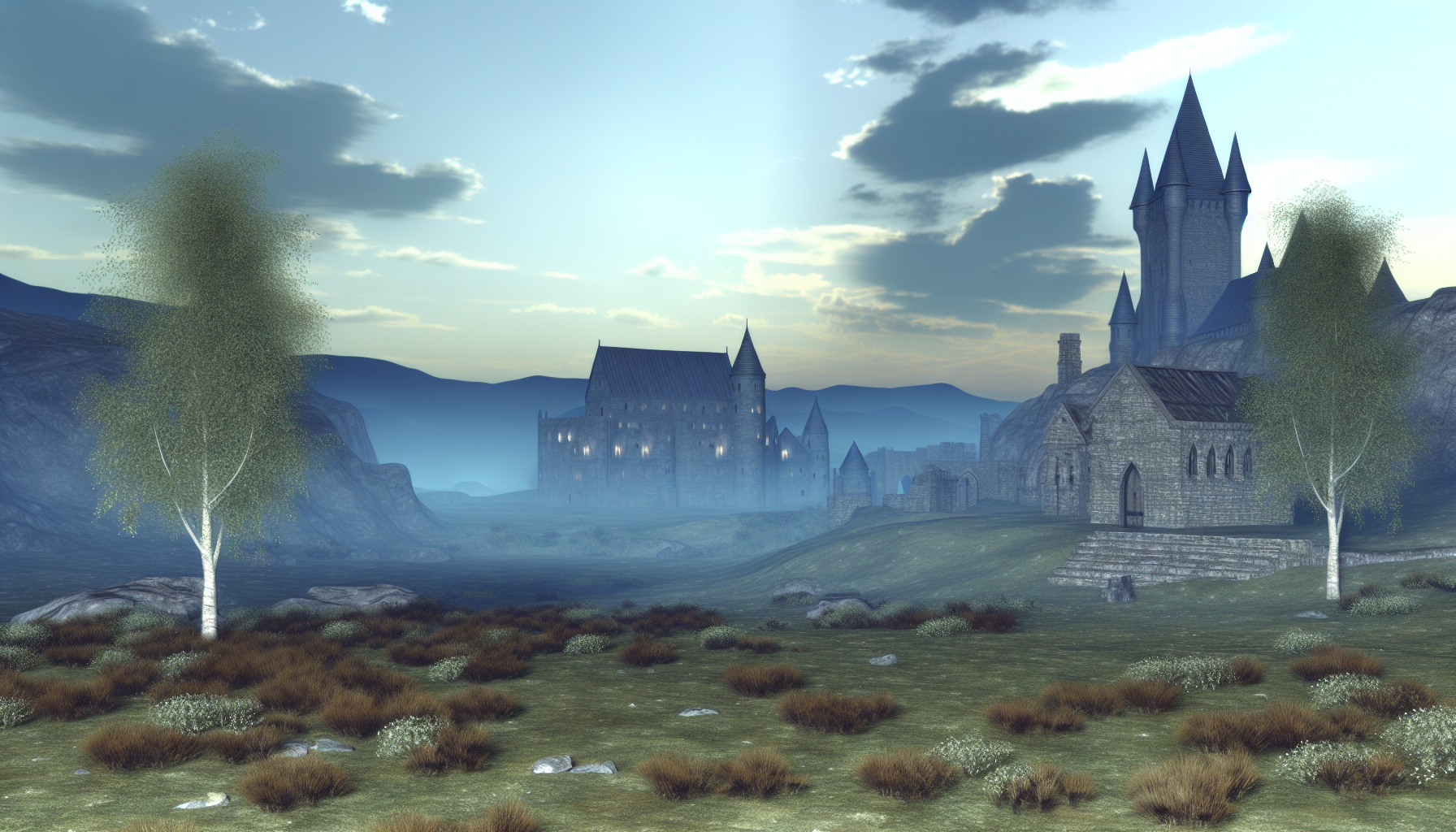
One of the greatest visual characteristics of “Frieren: Beyond Journey’s End” is its medieval European architectural style. The cities and villages appearing in the work feature designs reminiscent of medieval Germany and France, with stone buildings, tall spires, and walled cities.
The details of buildings include arched windows, half-timbered walls, stone-paved roads, and church bell towers, faithfully reproducing elements of historical architecture. These depictions serve not merely as background but as stages for the story, granting realism and playing a crucial role in immersing readers into the work’s world.
In the anime version, these architectural depictions are rendered even more precisely, with the addition of light and shadow expression and texture description, creating more three-dimensional and appealing landscapes.
Depictions of Castles and Fortresses
The story features various castles and fortresses. These structures possess characteristics of medieval castle architecture that prioritizes defensive functions. High castle walls, watchtowers, drawbridges, and moats—elements found in actual medieval fortifications are depicted carefully.
Particularly, the fortified cities in the northern countries and the city of Oisserst where mage exams are held each possess unique architectural styles and vistas, allowing one to enjoy different landscape charms at each visited location.
Medieval Lifestyle Scenes
The worldview of “Frieren: Beyond Journey’s End” is evaluated as being brought quite close to authentic medieval life while maintaining entertainment value. Even in daily life scenes—market vistas, inn interiors, food depictions—the lifestyle of medieval Europe is reflected.
Lighting is fundamentally candlelight or torches, and transportation centers on walking or horse-drawn carriages. This attention to detail enhances the convincingness of the work’s world. However, rather than complete medieval reproduction, there is a balance struck with appropriate fantasy elements to make the story engaging.
The Beauty of Natural Landscapes and Depiction Techniques
Expression of Forests and Grasslands
In “Frieren: Beyond Journey’s End,” natural landscapes are equally important as urban environments. The journeys of Frieren and her companions feature diverse natural environments including deep forests, vast grasslands, and harsh mountain terrain.
Forest depictions employ subtle expressions that evoke the ecosystem of nature, such as tree density, how light filters through, and undergrowth growth patterns. Grassland scenes depict open landscapes with wind-blown grass movements, horizons stretching into the distance, and expansive skies.
These natural depictions serve not merely as background but also reflect characters’ emotions and set the atmosphere of the narrative.
Landscapes of Mountains and Passes
As a travel narrative, this work frequently features scenes crossing mountainous regions. The depiction expresses both the severity and beauty of mountains, with steep mountain paths, snowy passes, and exposed rocky cliffs.
These landscapes visually express the hardships of travel while serving as stages where characters’ growth and deepened bonds are depicted through overcoming these challenges.
Waterside Landscapes
Rivers, lakes, and seas—water landscapes are important elements of this work. Water surface reflections, wave movements, and water transparency all employ careful techniques in depicting water.
Particularly striking are conversation scenes at quiet lakeshores or walking scenes along riverbanks, where serene waterside landscapes are connected to characters’ internal dialogues and reminiscences. The quietness of water symbolizes inner peace and moments of contemplation.
Techniques and Characteristics of Background Art
Background Expression in Manga
The artwork by Tsukasa Abe is highly evaluated for the precision of background depiction. Within the constraints of the manga medium, with limited panels and pages, various techniques are employed to express rich landscapes.
The contrast between distant and near views, effective use of perspective, and texture expression through tone work all create three-dimensional landscapes with depth that are characteristic of manga techniques.
In particular, panoramic landscape depictions using full-page spreads make strong impressions on readers and effectively stage important narrative turning points and emotional scenes.
Evolution of Background Art in Animation
In the television anime version produced by MAPPA, the landscape depictions from the original work are expressed even more richly. Produced through a production committee system, this anime particularly invests effort in background art, which receives high evaluation.
Through anime’s unique color expression, light direction, and camera work, the original’s landscapes become more three-dimensional and vivid. Particularly subtle direction such as natural light expression, light changes by time of day, and atmosphere variations by weather conditions are applied.
Since its broadcast began, the beauty of its background art has become a topic on SNS and elsewhere, with many fans sharing screenshots of specific scenes, generating significant response.
Expression of Seasons and Time
Another characteristic of “Frieren: Beyond Journey’s End”‘s landscape depiction is the expression of seasonal changes and the passage of time. Spring flowers, summer greenery, autumn foliage, and winter snow scenes all add color to the narrative.
Furthermore, sunrise, bright midday light, sunset’s crimson hue, and night’s moonlight are carefully depicted. These expressions serve to visually reinforce an important theme of this work—the passage of time.
Sacred Site Pilgrimages: Models in Reality
Medieval German Cities
The landscapes in “Frieren: Beyond Journey’s End” are thought to be based on existing medieval European cities and scenery. In particular, medieval German cities are likely models for the cityscapes in the work.
Well-preserved medieval cities such as Rothenburg, Nuremberg, and Heidelberg contain numerous landscapes similar to those appearing in “Frieren: Beyond Journey’s End.” Stone-paved roads, half-timbered houses, city walls, and churches—elements of the work’s architectural style are visible in actual scenery.
Among fans, “sacred site pilgrimages” visiting these cities are conducted, with a way of enjoying comparing actual landscapes to those in the work becoming widespread.
Alpine Landscapes of Austria and Switzerland
The mountainous landscapes depicted in the work likely model the Alps. In the mountainous regions of Austria and Switzerland, harsh mountain paths similar to those in the work, beautiful alpine flora, and snow-covered peaks exist.
The traditional mountain lodges and village architecture in these regions also share common points with the mountain settlement depictions in the work.
Natural Landscapes of Northern Europe
The landscapes of the northern countries that serve as the story’s setting show influences from Northern European nature. Depictions reminiscent of Scandinavian landscapes appear, including vast forests, lake districts, and harsh winter climates.
Collaboration Facilities within Japan
In 2026, a collaboration project between the agricultural resort “THE FARM” and “Frieren: Beyond Journey’s End” was implemented. For this project, six newly illustrated artworks were created featuring Frieren, Fern, Stark, Himmel, Heiter, and Eisen, with special visuals released where the naturally rich landscapes of THE FARM overlap with the lingering sentiment of the narrative.
Such projects attract attention as new attempts at connecting fantasy work landscapes with real natural scenery.
The Role Landscapes Play in the Narrative
Visualizing the Passage of Time
One central theme of “Frieren: Beyond Journey’s End” is “time.” For Frieren, an elf living over a thousand years, a human lifetime is but a moment. Landscape depiction plays a crucial role in expressing this difference in time perception.
In scenes revisiting the same location in different eras, time’s passage is visually expressed through landscape changes such as building deterioration, tree growth, and urban development. Conversely, natural landscapes contain elements unchanged after hundreds of years, depicting a contrast between eternity and change.
Emotion Projection
Landscape depiction functions as a mirror reflecting characters’ emotions. Classical techniques such as cloudy skies and rain in sad scenes, or clear weather and beautiful sunsets in joyful scenes, are employed, yet more subtle emotional expressions are embedded in landscapes.
For instance, when visiting locations of memories with Himmel, the landscape itself becomes a medium of memory, visually expressing Frieren’s internal changes.
Travel Experience and the Expanse of the World
This work is a travel narrative, and landscape diversity expresses the world’s vastness. By depicting different landscapes at each visited location, readers experience the reality of a long journey and perceive the existence of a broad world.
Moreover, by tracing the same journey paths, the past hero party’s travels and Frieren’s current journey overlap, adding depth to the narrative.
Attention to Detail in Fantasy Landscapes
Flora and Ecosystems
The natural depictions in “Frieren: Beyond Journey’s End” possess botanical accuracy alongside aesthetic beauty. Forests depict various tree species, and vegetation changes by region and altitude are expressed.
Grasslands bloom with different flowers by season, and alpine flora appear in mountainous regions, providing realism to plant depiction. This attention to detail creates convincing landscapes despite the fantasy setting.
Regional Differences in Architecture
Cities and villages appearing in the work each possess distinct architectural styles. Buildings in warm southern regions differ structurally from those in cold northern regions, and decoration styles vary by cultural sphere.
Such expressions of regional differences demonstrate the world’s diversity while implying each location possesses its own history and culture.
The Relationship Between Magic and Landscape
The existence of magic in this world influences landscapes. Magic-constructed buildings, natural phenomena affected by magic, and special structures of mage dwellings show unique expressions where magic and fantasy landscapes merge.
However, balance is maintained so magic doesn’t render landscapes excessively unrealistic. Magic is a special existence, and the world’s basic laws are set as shared with reality, supporting the landscape’s realism.
Evaluation and Technology of Background Art in the Anime Version
Production Structure and Art Direction
The anime version of “Frieren: Beyond Journey’s End” produced by MAPPA is known as a work particularly invested in background art. Under experienced art directors, the background art team successfully expresses the original’s worldview faithfully while enriching it further.
With different landscapes appearing in each episode, an enormous quantity of background paintings has been produced. The maintenance of high quality across all backgrounds while preserving a unified worldview demonstrates the production team’s technical skill.
Application of Digital Technology
Modern animation production applies digital technology to background art. “Frieren: Beyond Journey’s End” employs various digital techniques including 3DCG for architectural construction, digital painting for texture expression, and effects for light direction.
However, the representation balances technological reliance with retained warmth from hand-drawing. Particularly in natural landscape depiction, the softness and organic texture characteristic of hand-drawing is preserved.
Color Design and Light Direction
Particularly impressive in the anime’s background art are color design and light direction. Meticulous color design is applied to light changes by time and weather, color tone differences by season, and atmosphere-expressing colors by location.
Especially in twilight and sunrise scenes, beautiful sky expression using gradation captivates many viewers. Furthermore, light and shadow contrast in interior scenes and dappled sunlight in forests provide depth and three-dimensionality to landscapes.
Fan Art and Landscape Expression in Community
Fan Art on pixiv and Similar Sites
Accompanying “Frieren: Beyond Journey’s End”‘s popularity, numerous fan artworks are posted on illustration sites like pixiv. Among these, many depict scenes from the work with unique interpretations.
Fan artists, referencing original and anime landscapes, express the work’s world from their own perspectives. Beyond character depictions, many works feature landscapes themselves as subjects, showing the work’s scenery stimulates creative inspiration broadly.
Sacred Site Pilgrimage Photos and Comparison
On SNS, fans visiting actual European cities and landscapes post photos finding places similar to those in “Frieren: Beyond Journey’s End.” Comparing actual scenery with those in the work allows exploration of the narrative’s landscape realism and possible model locations, expanding enjoyment methods.
Landscape Importance in Derivative Works
In “Frieren: Beyond Journey’s End” derivative works, landscapes are frequently treated as important elements. When reproducing specific original scenes, backgrounds receive careful attention alongside characters, becoming expressions of affection toward the work.
Additionally, creative works imagining new locations not appearing in the original are seen, with observable expansion of the “Frieren: Beyond Journey’s End” world.
Comparison with Other Fantasy Works
Differences from Conventional Fantasy Works
Many fantasy manga and anime, while claiming “medieval European style,” typically contain numerous modern elements. However, “Frieren: Beyond Journey’s End,” while maintaining entertainment value, distinctly moves toward a more authentic medieval worldview.
Realism toward the medieval period is pursued across multiple aspects including lighting, transportation, architectural technology, and social structures. This distinguishes the work from many other fantasy works.
Density of Background Depiction
“Frieren: Beyond Journey’s End” ranks highly compared to other works regarding background depiction density. While many manga works simplify backgrounds due to production schedule constraints, this work maintains consistently careful background depiction.
This background quality supports the overall work’s quality and heightens reader and viewer immersion—a crucial element.
Landscape as a Work Depicting “Journey”
While many fantasy works feature journey themes, “Frieren: Beyond Journey’s End” is noteworthy for landscape diversity and quality. Different landscapes carefully depicted at each location meaningfully contribute to the narrative.
Rather than serving merely as movement backgrounds, landscapes themselves function as narrative components—a defining characteristic of this work.
The “Warm Fuzzy” Feeling Created by Landscape Depiction
Warmth of Daily Landscapes
“Frieren: Beyond Journey’s End,” while an epic adventure fantasy, invests effort in depicting everyday scenery. Careful depiction of ordinary scenes—a night at an inn, shopping at markets, resting by roadsides—creates warmth throughout the work.
These daily landscapes provide readers and viewers with “warm fuzzy” sensations, creating contrast with intense battle scenes and tense moments.
Harmony with Nature
The work frequently depicts characters spending time in nature. Scenes like camping in forests, eating by riverbeds, and resting in grasslands—landscapes harmonizing with nature add healing elements to the narrative.
These landscapes provide modern readers and viewers with comfort separate from daily life.
Slow-Paced Travel Depiction
The journey in “Frieren: Beyond Journey’s End” is depicted as leisurely visiting locations rather than hastily reaching destinations. This travel pace creates time to savor landscapes slowly, forming the work’s calm atmosphere.
Slow landscape appreciation in travel depiction contrasts with modern hurried life, becoming appealing to many readers and viewers.
Future Developments and Possibilities in Landscape Expression
Original Manga Continuation and New Landscapes
The original “Frieren: Beyond Journey’s End” manga is currently ongoing, with future journeys to new locations expected. Landscapes from previously unvisited regions, architectural styles from new cultural spheres, and unfamiliar natural environments may appear.
As the story progresses and the world’s overall structure becomes clearer, landscape expression is expected to become increasingly rich.
Expectations for Anime Second Season and Beyond
The anime version’s success brings expectations for future series continuation. The high-quality background art established in Season One is hoped to continue through future installments.
Later original storyline sections feature particularly impressive landscapes, with how these are expressed in anime garnering significant attention.
Community Interest in Landscapes
Fan communities of “Frieren: Beyond Journey’s End” demonstrate high interest in landscapes, with this trend expected to continue. Landscapes become topics through sacred site pilgrimages, fan art, and analysis, forming cultures enabling multifaceted world enjoyment.
Such fan activities further increase work popularity and attract new fans.
Conclusion: The World Told by “Frieren: Beyond Journey’s End”‘s Landscapes
The fantasy landscapes in “Frieren: Beyond Journey’s End” carry meaning beyond mere background. Medieval European architectural inspiration, rich natural depiction, attention to detail, and landscape expression connected to narrative themes greatly enhance the work’s appeal.
Meticulous background depiction in the original manga, beautiful background art in the anime version, and heightened community landscape interest demonstrate “Frieren: Beyond Journey’s End” as a visually excellent work.
This work’s central themes—time’s passage, memory and loss, human bonds—are expressed more deeply and emotionally through landscape depiction. Landscapes themselves tell stories, reflect characters’ emotions, and reveal the world’s vastness.
“Frieren: Beyond Journey’s End”‘s fantasy landscapes will continue captivating many readers and viewers. With original serialization continuing and anime series expanding, increasingly diverse and beautiful landscapes are anticipated. Through these landscapes, we can rediscover time’s value, the meaning of human encounter, and the joy of travel.