
The worldview of the popular anime “Demon Slayer” is deeply connected to the history and mythology of various regions across Japan. Among these, Shimane Prefecture, centered around Izumo Grand Shrine and serving as the stage of mythology, as well as a place where numerous legends related to “demons” remain, has garnered attention from Demon Slayer fans.
This article provides a thorough guide to Izumo Grand Shrine and Demon Slayer-related spots in Shimane Prefecture. We will introduce in detail the connections between the world of mythology and the work, actual sacred sites worth visiting, and information useful for trip planning.
The Relationship Between Izumo Grand Shrine and Demon Slayer
Kami-ari Month and the Gathering Place of Gods
Izumo Grand Shrine is a venerable shrine recorded in Japan’s oldest historical text, the “Kojiki.” Every year in the tenth lunar month, it is said that eight million gods from all across the nation gather at Izumo Grand Shrine, and this month is called “Kami-ari Month (Kamiaridzuki)” in Izumo. Meanwhile, in other regions, gods are absent, so the month is called “Kannadzuki” (Month Without Gods).
In the worldview of “Demon Slayer,” Shintoism and Japanese mythology are depicted as important elements. The “Hinokami Kagura” performed by the protagonist Tanjiro Kamado is derived from kagura, a Shinto ritual dance, and scholars have pointed out its connection to the kagura performed at Izumo Grand Shrine.
Susanoo no Mikoto and the Demon-Slaying Mythology
The chief deity enshrined at Izumo Grand Shrine is Okuninushi no Okami, but throughout Shimane Prefecture, numerous myths related to Susanoo no Mikoto remain. Susanoo is known as a hero who defeated Yamata no Orochi, an eight-headed great serpent.
This mythological structure of “monster slaying” overlaps with the battles between the Demon Slayer Corps and demons in “Demon Slayer.” The scene of Tanjiro and his companions defeating demons to protect people mirrors the story in which Susanoo defeated the Orochi that tormented the people.
Izumo Grand Shrine’s Architecture and the Work’s Worldview
The main hall of Izumo Grand Shrine is a magnificent structure reaching a height of 24 meters. Some theories suggest that in ancient times it was more than twice as tall, at 48 meters, and its immense scale evokes the world of gods.
The depictions of non-realistic architectural spaces in “Demon Slayer,” such as the Infinite Castle and the headquarters of Muzan Kibutsuji, reflect the aesthetics of traditional Japanese architecture. The solemn atmosphere of Izumo Grand Shrine shares something with the sense of scale of the work’s world.
Complete Guide to Demon Slayer Sacred Sites in Shimane Prefecture
Izumo Grand Shrine (Izumo City)
Basic Information
- Location: 195 Kihikihigashi, Taisha-cho, Izumo City, Shimane Prefecture
- Visitation Hours: 6:00–20:00 (varies by season)
- Admission: Free
- Access: Approximately 10 minutes on foot from Izumo Taisha-mae Station on the Ichibata Railway
Izumo Grand Shrine is nationally famous as the deity of marriage relations, but for Demon Slayer fans, it is a symbolic spot where mythology and the work’s world intersect. Within the shrine grounds are multiple subsidiary shrines, each containing the stories of mythology.
Highlights
- Main Hall: A representative example of “Taisha-zukuri,” Japan’s oldest shrine architectural style
- Kagura Hall: The sacred rope 13.5 meters long is spectacular
- Soga Shrine: A shrine dedicated to Susanoo no Mikoto
When paying respects, follow the “two bows, four claps, one bow” ritual unique to Izumo Grand Shrine. This ritual, different from that of ordinary shrines, conveys the special nature of this place.
Kijin Shrine (Okuizumo Town)
Basic Information
- Location: 1060 Oomaki, Okuizumo Town, Nita County, Shimane Prefecture
- Enshrined Deity: Isotakeru no Mikoto, Susanoo no Mikoto
- History: Boasts approximately 1200 years of history
A must-see shrine for Demon Slayer fans. The inclusion of the character “demon (oni)” in its name has garnered attention in connection with the work. Standing in the quiet mountains of the Torigami district, this shrine has nearly 1200 years of history and has long been a center of regional faith.
Characteristics
- A rare shrine with “demon (oni)” in its name
- Enshrines Susanoo no Mikoto
- The main hall was rebuilt in 1915, but its history dates back to ancient times
The area surrounding the shrine is rich in nature, reminiscent of the mountain scenery depicted in the work. When visiting, please be mindful of proper etiquette in a quiet environment.
Oni no Shitaburui (Okuizumo Town)
Basic Information
- Location: Minari, Okuizumo Town, Nita County, Shimane Prefecture
- Designation: National Place of Scenic Beauty and Natural Monument
- Access: Approximately 10 minutes by car from JR Izumo Minari Station
Oni no Shitaburui is a gorge stretching approximately two kilometers created by the rapids of Oomaki River, a tributary of the Hii River. The landscape of strange rocks and unusual formations is spectacular and is designated as a National Place of Scenic Beauty and Natural Monument.
Connection to Demon Slayer
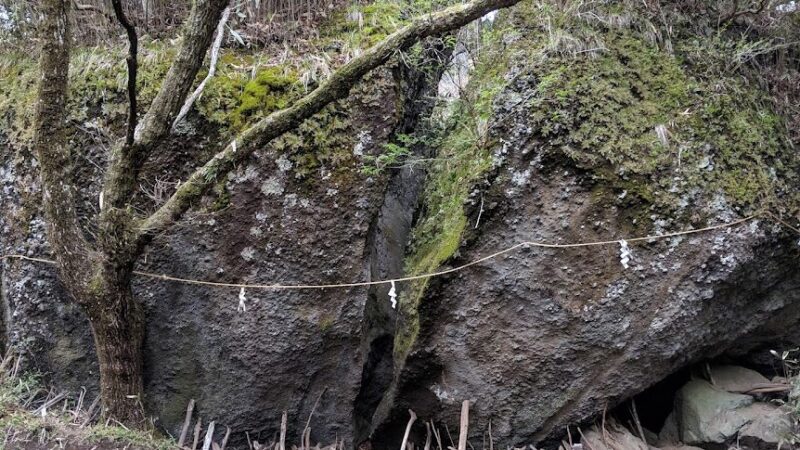
The greatest highlight is the “Oni no Shitaburui Rock (Trial-Cutting Stone).” This massive boulder became a topic of discussion as it reminds viewers of the scene in Volume 1 of the anime “Demon Slayer” where protagonist Tanjiro faces a trial set by his mentor Sakonji Urokodaki before the Final Selection, during which he cuts through a large rock.
Upon visiting, one is overwhelmed by the imposing appearance of the rock. Fans continue to flock to this place, imagining Tanjiro’s great accomplishment through his training.
Mythology and Legend
A legend remains that a beautiful goddess named Tamaday-hime once lived in this place. One day, the man she fell in love with turned out to be a great serpent (Orochi), and as the startled princess fled, she trembled her tongue, which is said to be the origin of the name “Shitaburui (tongue trembling).”
Walking Course
- Promenade: Approximately 1.6 kilometers (approximately 1 hour)
- Suspension Bridge: “Shitaburui’s