
Kibitsu Shrine, located in Kita Ward, Okayama City, Okayama Prefecture, is a mystical place where Japan’s oldest demon-slaying legend remains. As the global boom of “Demon Slayer: Kimetsu no Yaiba” brings renewed attention to the existence of “demons,” this shrine can be said to be the true sacred site of demon legends in Japan. It is the stage of a fierce battle between Kibitsu Hiko no Mikoto (the prototype of the Momotaro fairy tale) and Ura, a demon, and the legend that the demon’s severed head is still buried here is passed down to this day.
This article will convey all the attractions of this ancient shrine, from the relationship between Kibitsu Shrine and Demon Slayer, the roots of the Momotaro legend, the highlights of the National Treasure architecture, to the mysterious Narukamakami ritual.
The Relationship Between Kibitsu Shrine and Demon Slayer
“Demon Slayer: Kimetsu no Yaiba” depicts the battle between demons and demon slayers, but ancient Japanese demon legends flow through its foundation. Kibitsu Shrine, as the place where Japan’s oldest and most concrete demon-slaying legend remains, is attracting attention among Demon Slayer fans as the “true sacred site of demon legends.”
The Origin of Japanese Demon Legends
When people in Japan think of “demons,” the Momotaro fairy tale is most famous, but the prototype of this Momotaro legend is precisely the battle between Kibitsu Hiko no Mikoto and Ura that is transmitted at Kibitsu Shrine. This legend is not merely a fairy tale but likely reflects historical facts from ancient times, with related descriptions found in both the “Nihon Shoki” and “Kojiki.”
Now that the world is paying attention to demons due to the “Demon Slayer” boom, if asked where the sacred site of demons is, one should undoubtedly answer Kibitsu Shrine in Kibi Province (Okayama Prefecture). This shrine preserves numerous places where one can actually experience the stage of the legend, such as Yazoki Rock, where the demon-slaying arrows are said to have been placed, and Okamaden, said to be where the demon’s head was buried.
Common Points with Demon Slayer
In “Demon Slayer,” the Demon Slayer Corps battles demons, but in the legend of Kibitsu Shrine, Kibitsu Hiko no Mikoto dispatched from the imperial court battles the evil demon Ura. Both share the same structure of “righteous warriors defeating demons that torment people,” and the prototype of the demon-slaying story deeply rooted in the Japanese heart lies here.
The History and Origins of Kibitsu Shrine
As the Chief Shrine of Kibi Province
Kibitsu Shrine has been revered as the chief shrine of ancient Kibi Province (a vast area encompassing present-day Okayama Prefecture, the eastern part of Hiroshima Prefecture, and island regions of Kagawa Prefecture). It is situated on the northwestern base of Kibi Nakayama (elevation 175 meters), facing north, and is located at the boundary between Bizen and Bichū Provinces in the western part of Okayama City.
As a Shikinaisha (shrine listed in the Engishiki) and Meishin Taisha (Major Shrine), it was originally the guardian deity of all of Kibi Province. After Kibi Province was divided into three provinces—Bizen, Bichū, and Bingo—it became the First Shrine of Bichū Province. Nevertheless, it continues to receive devoted worship from throughout the Kibi region.
The Enshrined Deity: Great Kibitsu Hiko Great Kami
The enshrined deity of Kibitsu Shrine is Great Kibitsu Hiko Great Kami (Ōkibitsu Hiko no Ōkami). Born as a prince of the seventh Emperor Kōrei, he was dispatched as one of the Four Road Generals along the Sanyōdō Route and is said to have pacified this region.
Great Kibitsu Hiko no Mikoto pacified an evil person named Ura and established peace and order in Kibi Province. For his accomplishments, after living to the remarkable age of 281, he was buried at the summit of Kibi Nakayama and came to be enshrined as a deity. This is regarded as the origin of Kibitsu Shrine.
The Truth of the Momotaro Legend: The Battle Between Kibitsu Hiko no Mikoto and Ura
Who Was Ura?
Ura is said to have been either a prince of Baekje or the leader of a group of immigrants with iron-forging technology from a foreign land. With a height exceeding four meters, red hair, and tiger-like glowing eyes, he appeared truly demon-like.
Ura used Kii Castle (Kiinonjō) located west of Kibi Nakayama as his base, repeatedly raiding and plundering surrounding villages. Unable to bear his tyranny, the people made their pleas to the imperial court, which dispatched Kibitsu Hiko no Mikoto.
Record of the Fierce Battle
The battle between Kibitsu Hiko no Mikoto and Ura was intense. When Kibitsu Hiko no Mikoto released an arrow, Ura threw rocks in retaliation. Then Kibitsu Hiko no Mikoto employed a strategy of releasing two arrows simultaneously. One shattered against the rock, but the other pierced Ura’s left eye.
Wounded, Ura transformed into a pheasant to escape, but Kibitsu Hiko no Mikoto transformed into a hawk to pursue. When Ura changed into a carp and fled into a river, Kibitsu Hiko no Mikoto became a cormorant and captured him. This legend became the prototype of the Momotaro fairy tale in which Momotaro sets out on his demon-slaying quest accompanied by a dog, monkey, and pheasant.
Okamaden: Where the Demon’s Head Is Buried
Finally captured, Ura had his head severed. However, no matter how many times the head was buried, it would appear on the ground and continued to howl. Unable to manage, Kibitsu Hiko no Mikoto commanded Inukai Takeru no Mikoto (Dog-Keeper Takeru) to bury it beneath the kettle in Okamaden, where it finally fell silent.
Today, the legend persists that the head of the demon subdued by the enshrined deity is buried beneath Okamaden, and a special ritual called Narukamakami is performed at this location. This ritual of divining good and bad fortune by the sound of the kettle became famous throughout the realm by the Muromachi period and appears in “The Cauldron of Kibitsu” from the Edo-period collection of supernatural tales “Tales of Moonlight and Rain.”
The Beauty of the National Treasure Architecture: “Kibitsu-Zukuri”
A Unique Architectural Style
The main hall and worship hall of Kibitsu Shrine were rebuilt in 1425 (Ōei 32) and are designated as National Treasures. Their most distinctive feature is an architectural style called “Kibitsu-Zukuri” (Hiyoku Irimoya-Zukuri), the only one of its kind in the entire country.
The structure combines two irimoya-style roofs placed side by side into one, resembling a pair of birds spreading their wings. Because this architectural style has no parallel elsewhere, it came to be called by the specific name “Kibitsu-Zukuri.”
The Grandeur of the Main Hall
The main hall boasts imposing dimensions of eight bays on the front and six bays on the sides. The cypress bark roof traces elegant curves, while the red-lacquered pillars and white walls create a striking contrast. Inside, ornate fusuma paintings by the Kanō school remain, conveying the finest craftsmanship and artistry of the Muromachi period to the present day.
The worship hall is integrated structurally with the main hall, enveloping visitors in a solemn atmosphere. This integrated structure of the main and worship halls is also a characteristic of Kibitsu-Zukuri.
The Impressive Corridor
Another highlight of Kibitsu Shrine is the approximately 360-meter corridor extending from the main hall southward to the group of subsidiary shrines. This corridor was constructed along the natural topography of Kibi Nakayama, describing a gentle undulation as it continues.
The corridor roof traces beautiful curves reminiscent of a dragon’s body and is also called the “dragon’s back.” In spring, fresh greenery adorns the corridor, and in autumn, crimson leaves paint it in brilliant colors, allowing visitors to enjoy the character of each season. Simply walking through this corridor allows one to experience the mystical atmosphere of a sacred space continuing from ancient times.
The corridor was built between 1579 (Tenshō 7) and 1605 (Keichō 10) and is designated as an Important Cultural Property. Its length and beauty stand out among shrine architecture nationwide and are well worth seeing.
The Mystical Narukamakami Ritual
Divine Oracles from the Demon’s Head
The Narukamakami ritual (Naru-Kama-Shinjī) is known as the most mystical ritual at Kibitsu Shrine. Performed at Okamaden, this ritual involves the head of Ura buried beneath the kettle sounding it to divine fortune and misfortune.
During the ritual, a shrine maiden chants norito (Shinto prayers) before the kettle. The size, duration, and resonance of the sounds emitted from the kettle determine the fulfillment of wishes and one’s fortune. A loud, prolonged sound indicates great good fortune, while a short, weak sound suggests bad omens.
Spiritual Efficacy Continuing from the Muromachi Period
The spiritual efficacy of the Narukamakami ritual was known throughout the realm at least by the Muromachi period, and many people visited Kibitsu Shrine to divine their fortune. “The Cauldron of Kibitsu,” included in Ueda Akinari’s “Tales of Moonlight and Rain,” is a supernatural tale based on this ritual, and it became even more widely known during the Edo period.
In modern times, the Narukamakami ritual remains beloved by many, and there is no shortage of visitors seeking divine guidance at life’s turning points or before making important decisions. Since it is performed by reservation, those wishing to experience it are advised to contact the shrine in advance.
Notable Spots Within the Shrine Grounds
Yazoki Rock (Arrow-Placing Rock)
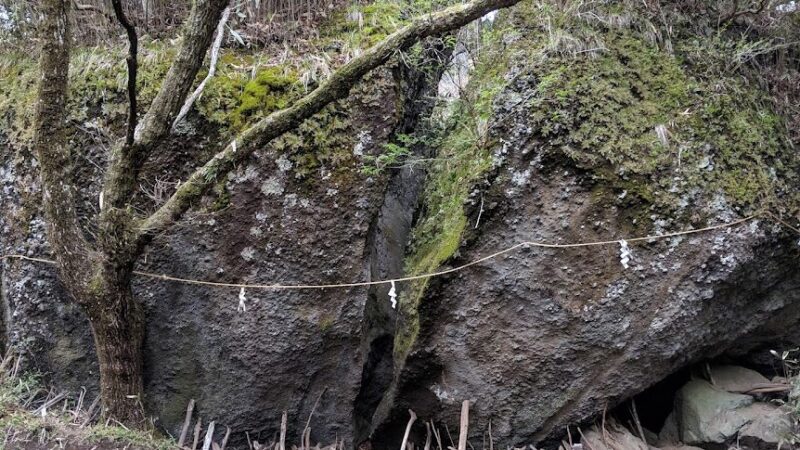
The large rock beside the torii gate along the approach to the main hall is Yazoki Rock. It is said to be the place where Kibitsu Hiko no Mikoto placed the arrows he used in his battle with Ura and is one of the important stages of the Momotaro legend.
Standing before this rock, one seems to sense the tension of the ancient battle. Many visitors take commemorative photographs in front of this rock.
Okamaden (The Divine Kettle Hall)
Okamaden, said to be where Ura’s head is buried, is the most mysterious place at Kibitsu Shrine. The Narukamakami ritual performed here offers a precious opportunity to experience the legend that the demon’s head still delivers divine oracles.
The building itself holds high historical value and is filled with a sacred atmosphere. Standing before Okamaden, one experiences a strange sensation where legend and reality intertwine.
Ichidōsha Shrine
The Ichidōsha Shrine along the corridor is said to enshrine Inukai Takeru no Mikoto, regarded as the model for the “dog” in the Momotaro legend. He is known for his achievement in burying Ura’s head at Okamaden.
The Stage of the Yaritate Ritual
The Yaritate ritual performed on the second Sunday of October each year is conducted in remembrance of Kibitsu Hiko no Mikoto’s arrow release against Ura. On this day, many visitors gather, and one can witness a magnificent ceremonial reenactment of the ancient battle.
Kibitsu Shrine and Surrounding Demon Legend Spots
The Relationship with Kibitsu Hiko Shrine
About three kilometers east of Kibitsu Shrine stands Kibitsu Hiko Shrine, which also enshrines Kibitsu Hiko no Mikoto. This shrine serves as the First Shrine of Bizen Province, while Kibitsu Shrine is the First Shrine of Bichū Province, and it is revered as the guardian deity of the Bizen side.
Both shrines originally shared a single sphere of worship and maintain a deep relationship even after Kibi Province’s division. To gain a deeper understanding of the Momotaro legend, visiting both shrines is recommended.
Kii Castle (Ancient Mountain Fortress)
Kii Castle, said to be Ura’s stronghold, is an ancient mountain fortress located approximately ten kilometers west of Kibitsu Shrine. Built atop a mountain at about 400 meters elevation, this grand castle ruins feature approximately 2.8 kilometers of remaining defensive walls.
From Kii Castle, one can overlook the Kibi Plain and imagine how Ura ruled this land. With reconstructed walls and a western gate, this precious historical site allows visitors to experience the form of an ancient mountain fortress.
Yaguino-miya Shrine
The location where the arrow released by Kibitsu Hiko no Mikoto collided in mid-air with the rock thrown by Ura is said to be Yaguino-miya Shrine. The place name “Yagui” derives directly from this legend.
A large boulder called “Yagui Stone” remains at this location today, bearing witness to the intensity of the fierce battle.
Basic Information
How to Access
By Train
- Approximately 10 minutes on foot from “Kibitsu Station” on the JR Kibi Line
- Approximately 15 minutes by Kibi Line from JR Okayama Station
By Car
- Approximately 15 minutes from “Okayama IC” on the Sanyō Expressway
- Approximately 20 minutes from central Okayama
- Free parking available (capacity for approximately 400 vehicles)
Visiting Hours and Admission
- Visiting Hours: Shrine grounds open at all times (Social office: 9:00 AM – 5:00 PM)
- Admission: Free
- Narukamakami Ritual: By reservation, initial offering 5,000 yen and up
Location and Contact Information
- Address: 931 Kibitsu, Kita Ward, Okayama City, Okayama 701-1341
- Telephone: 086-287-4111
- Official Website: Latest information can be confirmed at the official Kibitsu Shrine website
Best Seasons to Visit
Kibitsu Shrine offers beautiful scenery throughout the year, but the following periods are especially recommended:
- Spring (April–May): The fresh greenery of the corridor is beautiful, and visitors can enjoy a refreshing visit
- Autumn (November): Crimson leaves paint the corridor in brilliant colors, making this the most beautiful season
- New Year Visits (January 1–3): Crowded with many visitors, offering a special atmosphere
- Yaritate Ritual (Second Sunday in October): Visitors can observe this ancient and venerable ritual
How to Enjoy a Visit to Kibitsu Shrine
Goshuin (Shrine Seals) and Amulets
At Kibitsu Shrine, visitors can receive beautiful goshuin. In addition to standard shrine seals, seasonal limited-edition versions are also available and are popular among goshuin collectors.
Amulets, particularly the “Arrow Amulet,” are especially famous, inspired by the arrows that Kibitsu Hiko no Mikoto used to shoot Ura. They are said to confer benefits of victory in competition and protection from misfortune.
Photography Spots
Kibitsu Shrine has numerous locations ideal for photography:
- The Corridor: Beautiful curved lines resembling the dragon’s back can be photographed
- The Main Hall: Capture the solemn appearance of the National Treasure architecture from the front
- Yazoki Rock: Photographing the torii gate and rock together creates an atmospheric effect
- The Corridor in Autumn Foliage Season: Guaranteed Instagram-worthy scenic beauty
Local Cuisine and Souvenirs
Several shops around Kibitsu Shrine sell kibidango, an Okayama specialty. As a souvenir inspired by the Momotaro legend, it is ideal.
Visitors venturing to central Okayama can also enjoy local cuisine such as Okayama ramen, demi-katsudon, and bara-zushi.
Conclusion: Experience Ancient Romance at the Sacred Site of Demon Legends
Kibitsu Shrine in Okayama Prefecture is the true sacred site of demon legends newly drawing attention due to the “Demon Slayer” boom. The oldest demon-slaying legend in Japan—the battle between Kibitsu Hiko no Mikoto and Ura, which became the prototype of the Momotaro fairy tale—remains here, and the mysterious Narukamakami ritual continues to be performed at Okamaden, where the demon’s head is said to be buried.
Numerous locations allow visitors to actually experience the stages of the legend, including the main hall (a National Treasure built in the unique Kibitsu-Zukuri architectural style found nowhere else in the country), a beautiful 360-meter corridor, Yazoki Rock, and Okamaden.
Kibitsu Shrine, where one can touch the world of demon legends continuing from ancient times and feel the depth of Japan’s history and culture, is a must-visit. When visiting Okayama, be sure to immerse yourself in the world of ancient romance at this mystical shrine. It is a leading tourist attraction in Okayama Prefecture, strongly recommended not only for Demon Slayer fans but also for history enthusiasts, architecture lovers, and those who enjoy visiting power spots.