
【Demon Slayer】Kamo Shrine (Tokyo) Complete Guide | Why to Visit for Sacred Site Pilgrimage and Access Information
The hit anime “Demon Slayer” has brought attention to shrines and mountains across Japan as sacred sites where fans can experience the world of the series. Among them, Kamo Shrine, located in Ome City, Tokyo, is a sacred pilgrimage spot that has quietly become a topic of conversation among Demon Slayer fans. This article provides detailed information about the connection between Kamo Shrine and Demon Slayer, notable features within the shrine grounds, points for worship, and access methods.
Kamo Shrine (Ome City, Tokyo)
Basic Information about Kamo Shrine
Kamo Shrine is a historic shrine located in Ome City, Tokyo. It belongs to the Kamo Shrine lineage with Kamigamo Shrine and Shimogamo Shrine in Kyoto as its head shrines, and has been revered as the local tutelary deity for many years.
Location: 3-862-1 Yuzuki-cho, Ome City, Tokyo
Principal Deity: Kamowakeikazuchino-kami
Founded: Details unknown (a shrine rooted in the local community since ancient times)
Shrine Rank: Former village shrine
Ome City is located in the western part of Tokyo and is surrounded by abundant nature. A tributary of the Tamagawa River flows around Kamo Shrine, where visitors can enjoy beautiful scenery throughout the four seasons.
History and Origins of Kamo Shrine
Kamo Shrine has been revered since ancient times as a shrine of water deities and thunder deities. Kamowakeikazuchino-kami is known as a deity of warding off evil, directional protection, and good fortune, and is cherished as a guardian of local residents’ lives.
Within the shrine grounds stands a sacred tree said to be several hundred years old, which speaks to its long history. The shrine also plays a central role in local festivals and welcomes many worshippers each year.
Connection to Demon Slayer
Why Kamo Shrine Attracts Attention as a Sacred Site
There are multiple reasons why Kamo Shrine is noted as a sacred site for Demon Slayer. First, there is a similarity in sound between “Kamado” (竈門), the surname of Tanjiro Kamado, one of the characters in the series, and “Kamo” (加茂), the name of this shrine.
More importantly, character names that appear in the series, particularly major members of the Demon Slayer Corps, are derived from shrines and place names throughout Japan. Kamo Shrine is an esteemed shrine lineage with Kamigamo Shrine and Shimogamo Shrine in Kyoto as its head shrines, and is one of the representatives of Japanese shrine culture.
Common Ground with the Work’s World
Demon Slayer is set in the Taisho era and incorporates elements of Japanese traditional culture and Shinto throughout the narrative. The solemn atmosphere that permeates the grounds of Kamo Shrine, the approach lined with ancient trees, and the traditional shrine architecture perfectly align with the work’s world.
In particular, the themes that the Demon Slayer Corps requires—”spiritual strength” and “harmony with nature”—are deeply connected to the concepts of “purification” and “rebirth” that shrines embody. By visiting Kamo Shrine, one can feel with their own senses the “peaceful daily lives of people” and “coexistence with nature” that Tanjiro and his companions sought to protect.
Nationwide Kamo Shrine Network
Kamo Shrines exist in many places throughout Japan, each functioning as the local guardian deity. Kamo Shrine in Ome City, Tokyo is one of them, enshrining the divided spirits of Kamomioya Shrine (Shimogamo Shrine) and Kamowakeikazuchi Shrine (Kamigamo Shrine) in Kyoto, which are the head shrines.
This network shares similarities with the organizational structure of the Demon Slayer Corps in Demon Slayer. Just as corps members stationed in various locations work together to fight demons, Kamo Shrines throughout the country function as a Shinto network.
Notable Features and Worship Points within the Shrine Grounds
Main Hall and Architectural Style
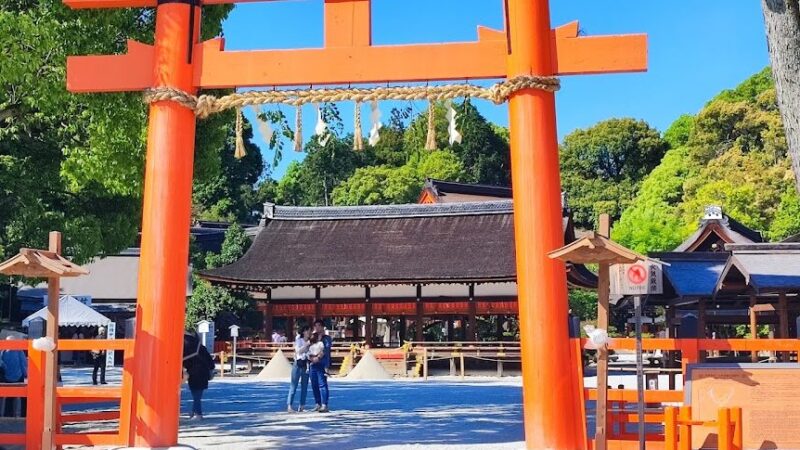
The main hall of Kamo Shrine preserves traditional shrine architecture, exuding a solemn yet simple atmosphere. The main sanctuary is built in the nagare-zukuri (flowing) style, characterized by the graceful curves of its roof.
A sacred rope (shimenawa) is hung in front of the prayer hall, welcoming worshippers. This rope serves as a boundary separating the sacred space from the secular world, and aligns with the image of a “sacred realm impervious to demons” in Demon Slayer.
Sacred Tree and Natural Environment
Within the shrine grounds stands an ancient tree estimated to be several hundred years old, evoking a sense of long history. This massive tree has been revered by local people as a “symbol of life force.”
In Demon Slayer, nature plays an important stage—from the misty mountains where Tanjiro trains to the bamboo grove where Nezuko sleeps. The rich natural environment of Kamo Shrine is ideal for experiencing the atmosphere of the work’s world.
Purification at the Water Basin
Before worship, one purifies oneself at the water basin. This cleansing ritual parallels the act of steadying one’s mind with the “Total Concentration Breathing” technique in Demon Slayer. By cleansing one’s hands and mouth with water, one can dispel daily distractions and approach the shrine with a sacred spirit.
How to perform the water basin ritual:
- Take the ladle with your right hand and rinse your left hand
- Switch to your left hand and rinse your right hand
- Switch back to your right hand, collect water in your left palm, and rinse your mouth
- Rinse your left hand once more
- Stand the ladle upright to rinse its handle, then return it to its place
Proper Worship Etiquette
The standard worship at Kamo Shrine is “two bows, two claps, one bow.”
- Make a light bow in front of the offering box
- Quietly place an offering
- Ring the bell if one is present
- Make two deep bows (two bows)
- Clap twice at chest height (two claps)
- Keep your hands together and silently offer your prayers
- End with one deep bow (one bow)
Performing this sequence carefully expresses respect to the deity.
Goshuin (Temple Stamp) Information
Goshuin of Kamo Shrine
Goshuin can be obtained at Kamo Shrine (availability may vary depending on whether the shrine office is open; advance confirmation is recommended). A goshuin serves as proof of worship and leaves a tangible record of one’s connection with the deity.
For Demon Slayer sacred site pilgrimages, collecting goshuin from various shrines becomes one of the pleasures of the journey. Within Tokyo, there are multiple sacred sites, such as Takino River Hachiman Shrine in Takinogawa (the birthplace of Shinobu Kocho) and Akagi Shrine in Ushigome (the birthplace of Zenitsu Agatsuma), making it possible to plan goshuin collection routes.
Etiquette When Receiving a Goshuin
A goshuin is not merely a stamp but proof of worship. Please observe the following etiquette:
- Always worship before requesting a goshuin
- Prepare a goshuin book (avoid using loose paper or regular notebooks)
- Prepare an offering fee (approximately 300-500 yen)
- Check the shrine office hours in advance
- Make your request using polite language
- Wait quietly while the goshuin is being written
Demon Slayer Sacred Site Network in Tokyo
Birthplaces of Major Characters (Tokyo)
According to the official fan book, Tokyo is set as the birthplace of multiple characters.
Shinobu Kocho (Insect Pillar): Tokyo Prefecture, Kita-Toshima County, Takinogawa Village (present-day Takinogawa, Kita Ward)
Takino River Hachiman Shrine is popular as a sacred site
Zenitsu Agatsuma (Thunder Breathing): Tokyo Prefecture, Ushigome Ward (present-day Ushigome, Shinjuku Ward)
Akagi Shrine is known as a sacred site
Inosuke Hashibira (Beast Breathing): Tokyo Prefecture, Mount Otake (Okutama)
A mountain standing 1,266 meters high, popular with hiking enthusiasts
Muichiro Tokito (Mist Pillar): Tokyo Prefecture, Mount Kageshin
A mountain standing 727 meters high, located on the border between Tokyo and Kanagawa
Example Routes for Sacred Site Pilgrimage in Tokyo
An example of a sacred site pilgrimage route including Kamo Shrine:
Urban Center Course:
- Asakusa (a scene where Muzan Kibutsuji appears)
- Akagi Shrine (Zenitsu Agatsuma’s birthplace in Ushigome)
- Takino River Hachiman Shrine (Shinobu Kocho’s birthplace in Takinogawa)
Western Tama Course:
- Kamo Shrine (Ome City)
- Mount Otake trailhead (Inosuke Hashibira’s birthplace)
- Mount Kumotori area (toward Tanjiro and Nezuko’s birthplace)
Mountain Climbing Course:
- Mount Kageshin (Muichiro Tokito’s birthplace)
- Mount Kumotori (Tanjiro and Nezuko’s birthplace)
- Mount Otake (Inosuke Hashibira’s birthplace)
Access and Surrounding Information
Access by Train
Nearest Stations: JR Ome Line “Kawabe Station” or “Higashi-Ome Station”
From Kawabe Station:
- Approximately 25 minutes on foot
- By bus: Get off at “Yuzuki-cho Sancho-me,” approximately 5 minutes on foot
From Higashi-Ome Station:
- Approximately 30 minutes on foot
- By taxi: Approximately 10 minutes
Access from the metropolitan area:
- From Shinjuku Station via JR Chuo Line to Tachikawa Station (approximately 40 minutes)
- Transfer to JR Ome Line at Tachikawa Station to Kawabe or Higashi-Ome Station (approximately 30 minutes)
- Total travel time: Approximately 1 hour 30 minutes
Access by Car
Via the Central Circular Expressway (Kan-etsu Expressway):
- Approximately 15 minutes from Ome IC
- Approximately 20 minutes from Hinoode IC
Parking: Parking may be available within the shrine grounds or in nearby spaces, but spaces are limited; the use of public transportation is recommended.
Nearby Attractions
Ome Railway Park: Recommended for railway enthusiasts. The Showa-era retro atmosphere pairs well with Demon Slayer’s Taisho-era setting
Mount Mitake: A spiritual mountain where Musashi Mitake Shrine is enshrined. The natural surroundings evoke the atmosphere of training
Lake Okutama: A lake with beautiful natural scenery that resembles the mountains where Tanjiro trained
Showa-era Retro Streets in Ome City: Shopping streets that preserve the atmosphere of the Taisho to early Showa periods
Best Times and Hours for Worship
Spring (March to May): A season of beautiful cherry blossoms and fresh greenery, ideal for worship. However, peak cherry blossom season may be crowded
Summer (June to August): Lush green foliage allows for worship combined with enjoying the cool shrine grounds. Early morning visits are recommended
Autumn (September to November): A season of beautiful autumn leaves and the time when the atmosphere of Demon Slayer’s world is most strongly felt
Winter (December to February): Worship in crisp, clear air allows for quiet contemplation. The New Year season may be crowded
Worship Hours: Generally from sunrise to sunset. Early morning visits (6:00 to 8:00 AM) are recommended, as there are fewer worshippers and the shrine is quieter.
How to Enjoy Sacred Site Pilgrimage and Etiquette
Experiences Gained from Sacred Site Pilgrimage
A sacred site pilgrimage for Demon Slayer offers value beyond mere tourism. Visiting the settings of the work and the birthplaces of characters deepens understanding of the narrative and offers new discoveries.
Experiences to be gained from visiting Kamo Shrine:
- A re-experiencing of the work’s world
- A deeper understanding of Japanese traditional culture and Shinto
- Spiritual purification through communion with nature
- Interaction with fellow fans who cherish the same work
- Discovery of local history and culture
Etiquette for Sacred Site Pilgrimage
The following etiquette is important for enjoying a sacred site pilgrimage:
Etiquette at Shrines:
- Walk along the edges of the approach path, as the center is the deity’s passage
- Avoid speaking loudly
- Eat and drink only in designated areas
- Always take trash with you
- Do not photograph in areas where photography is prohibited
- Consider not to disturb other worshippers
Consideration for Local Communities:
- Move quietly through residential areas
- Do not trespass on private property
- Greet local residents
- Support the local economy by patronizing local shops and cafes
Tips for a More Fulfilling Sacred Site Pilgrimage
Advance Preparation:
- Rewatch the series before your visit
- Research the shrine’s history and origins
- Confirm access methods and opening hours
- Prepare a goshuin book and camera
Ways to Enjoy at the Site:
- Take your time exploring the shrine grounds
- Observe seasonal flowers and nature
- Try talking to local residents
- Visit nearby tourist attractions
Keeping Records:
- Photography (respecting etiquette)
- Collecting goshuin
- Keeping a travel diary or blog
- Sharing on social media (be careful about spoilers and location identification)
The Deep Connection Between Demon Slayer and Shrine Culture
Shinto Elements Depicted in the Work
Demon Slayer deeply reflects Japanese Shinto culture. The “Nichirin Sword” used by the Demon Slayer Corps is connected to sun deity beliefs, and “wisteria flowers” symbolize purification and warding off evil. Additionally, breathing techniques such as “Water Breathing” and “Flame Breathing” parallel Shinto concepts of “misogi” (ritual purification) and “harae” (exorcism).
Since ancient times, shrines have been places to “exorcise impurity and return to a state of purity.” The mission of the Demon Slayer Corps in Demon Slayer similarly involves exorcising demons as “impurity” and restoring people’s peaceful lives. This commonality is one reason why many shrines are recognized as sacred sites.
Differences Between Nationwide “Kamado Shrines” and Kamo Shrine
The most famous sacred sites for Demon Slayer are “Houman Shrine Kamado Shrine” in Dazaifu, Fukuoka Prefecture, and “Hachiman Kamado Shrine” in Beppu, Oita Prefecture. These shrines, bearing the name “Kamado” like the protagonist Tanjiro Kamado’s surname, are visited by many fans.
In contrast, Kamo Shrine does not have a direct name match with “Kamado,” but as one of the representative Kamo Shrine lineages in Japan, it is a sacred site where one can experience the work’s world. While Kamado Shrines are places where one can feel a “direct connection with the protagonist,” Kamo Shrine is a place where one can experience “the world view of the entire work and the depths of Japanese culture.”
The Meaning of Shrine Worship
In modern society, shrine worship carries meaning beyond tourism. By stepping into a sacred space surrounded by nature, away from daily life, one can achieve peace of mind.
The characters in Demon Slayer, too, maintained spiritual strength by thinking of “what they should protect” and “the people they hold dear” amid harsh battles. By visiting Kamo Shrine and worshipping quietly, we too can gain the opportunity to reconsider what should be treasured in our daily lives.
Conclusion: Experience the World of Demon Slayer at Kamo Shrine
Kamo Shrine in Ome City, Tokyo is a sacred site worth visiting for Demon Slayer fans. Not only does it offer direct connection to the work, but experiencing Japanese traditional culture and Shinto worldview deepens understanding of the series.
With relatively good access from the metropolitan area and numerous other sacred sites and tourist attractions nearby, it can be incorporated into a day-long sacred site pilgrimage route. Why not immerse yourself in the world of Demon Slayer at Kamo Shrine, where you can enjoy the beauty of each season—the fresh green of spring, the deep green of summer, the autumn foliage, and the quiet of winter?
When visiting, remember to observe shrine etiquette and be considerate of the community. And in the quiet of the shrine grounds, reflect on the preciousness of the “peaceful daily life” that Tanjiro and his companions sought to protect. Enjoy your sacred site pilgrimage with total concentration.