【Demon Slayer】Complete Guide to Kintoki Mountain and Koitoki Lodging Stone (Kanagawa Prefecture) | The Appeal of Kintaro Legend and Sacred Pilgrimage Sites
Kintoki Mountain (elevation 1,212m), located on the border between Kanagawa and Shizuoka Prefectures, is a famous peak positioned at the northernmost point of the Hakone Outer Caldera Ridge. This mountain retains strong legends of Sakata Kintoki (Koitoki), whose childhood name was Kintaro, and in particular, “Koitoki Lodging Stone (Kintoki Lodging Stone)” is known as a massive boulder where Kintaro and his mother, the Mountain Witch, are said to have sheltered from night dew. In recent years, due to the connection between the legend of Kintaro and Rengoku Kyojuro, a character from the popular anime “Demon Slayer,” it has gained attention as a sacred pilgrimage site.
This article provides a thorough explanation of Kintoki Mountain and Koitoki Lodging Stone from every angle, including their appeal, access methods, climbing routes, historical background, and relationship to Demon Slayer.
Basic Information and Geographical Characteristics of Kintoki Mountain
Overview of Kintoki Mountain
Kintoki Mountain is the northernmost peak in the Hakone Outer Caldera Ridge, rising at the boundary between Hakone Town, Ashigara-Shimo District, Kanagawa Prefecture and Komaki Town, Sunto District, Shizuoka Prefecture. Despite its relatively modest elevation of 1,212m, the summit offers panoramic views of Mount Fuji, Sagami Bay, and the Hakone mountains, making it a spectacular spot visited by numerous climbers throughout the year.
Basic Data:
- Elevation: 1,212m
- Location: Hakone Town, Ashigara-Shimo District, Kanagawa Prefecture; Komaki Town, Sunto District, Shizuoka Prefecture
- Mountain Range: Hakone Outer Caldera Ridge
- Type: Lava Dome
- Climbing Season: April to November (climbing is possible in winter, but caution is needed for snow and ice)
- Climbing Time: Approximately 1.5 to 2 hours from the trailhead to the summit
Topography and Geological Characteristics
Kintoki Mountain is a lava dome formed by volcanic activity of the Hakone volcano approximately 400,000 years ago. The mountain body is composed of andesite lava, and large boulders are scattered throughout the surrounding area. These megaliths are linked to the Kintaro legend and are called by names such as “Kintoki Lodging Stone,” “Kintoki Handball Stone,” and “Kicked-Down Stone.”
It is also designated as part of the Hakone Geopark and serves as a valuable location for learning about volcanic history. From near the summit, you can see the entire Hakone Caldera, making it a geologically fascinating area.
Koitoki Lodging Stone (Kintoki Lodging Stone)
A Boulder Adorned with Legend
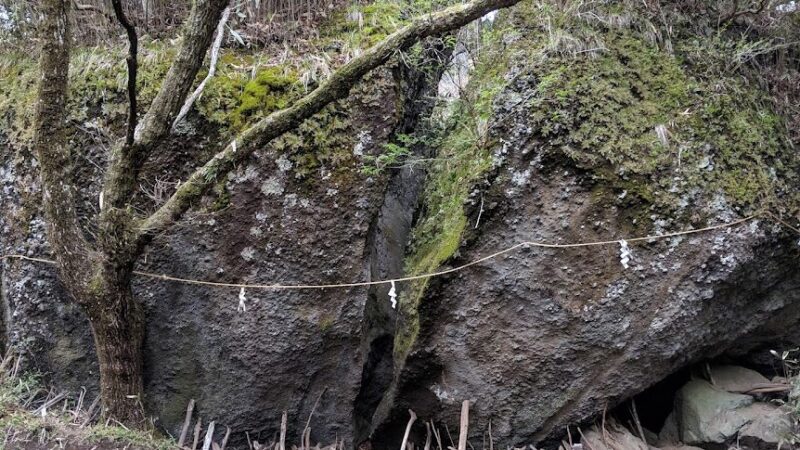
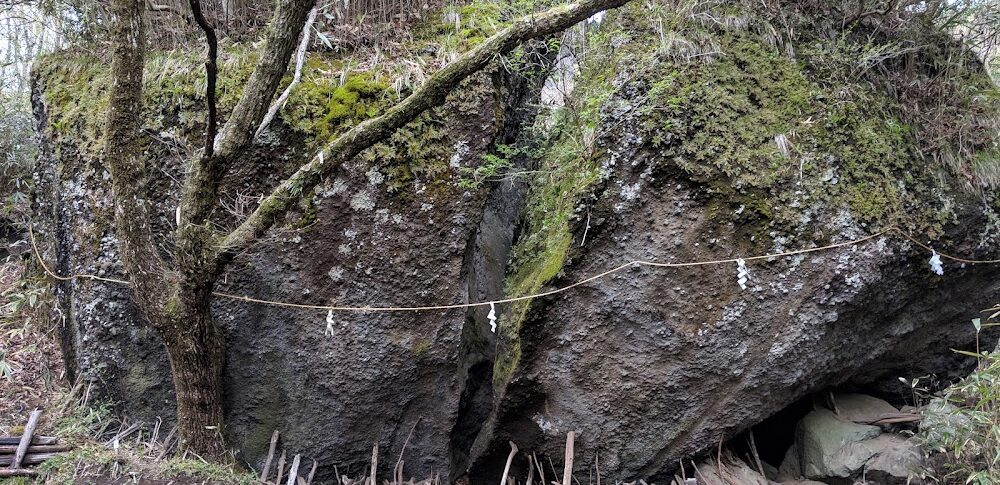
Koitoki Lodging Stone (Kintoki Lodging Stone) is a massive boulder approximately 10m high and 15m wide, located at an elevation of about 800m along the hiking trail from Koitoki Shrine (Kintoki Shrine) to Kintoki Mountain’s summit. The most notable feature of this boulder is that its central section is split in two.
According to legend, Kintaro (the childhood name of Sakata Kintoki) and his mother, the Mountain Witch, sheltered from rain and dew beneath this boulder and stayed there. The crack in the boulder naturally forms a cave-like space where several people can shelter from the rain.
The Legend of the Split in 1931
An interesting anecdote remains regarding the crack visible in the boulder today. It is said that on a certain day in Showa 6 (1931), this massive boulder suddenly split in two with a loud roar. Local residents feared it might be “Koitoki’s anger,” and thereafter came to cherish this boulder even more.
From a geological perspective, the crack is likely due to weathering within the rock and expansion/contraction caused by temperature changes, but by being connected with legend, it has come to be recognized as a more mystical place.
Access to the Lodging Stone and Points of Interest
Koitoki Lodging Stone is located about 30 to 40 minutes’ walk up the hiking trail from Koitoki Shrine. After passing “Kintoki Handball Stone” at the entrance of the hiking trail, a massive boulder with overwhelming presence eventually appears before you.
Points of Interest:
- The interior of the rock’s crack can be observed
- Moss and plants growing on the rock surface create a mystical atmosphere
- Natural sculptural beauty integrated with the surrounding forest
- Popular photography spot (especially during early morning light)
A small shrine stands before the boulder, and you can still see locals and climbers paying their respects.
The Kintaro Legend and the History of Sakata Kintoki
Overview of the Kintaro Legend
Kintaro is the protagonist of a representative Japanese folk tale, depicted as a boy wearing a red apron and carrying an axe. He is known as a boy of superhuman strength who grew up on Ashigara Mountain (the Ashigara Mountain Range including Kintoki Mountain), wrestling with bears and playing with animals.
According to legend, Kintaro was born as the child of the Mountain Witch and spent his early years in the area around Kintoki Mountain. Later, he was discovered by Minamoto no Raikou and became his retainer, taking the name Sakata Kintoki (Koitoki). As one of Raikou’s Four Heavenly Kings, he is said to have been active in feats such as subduing the demon Shuten-doji of Mount Ooe.
Historical Background and Actual Existence
Sakata Kintoki is believed to have been a real warrior of the Heian period’s middle years, though detailed historical records are scarce, with legend and fact intertwined. His name appears in classical literature such as “Konjaku Monogatari Shu” and “The Tale of the Heike,” and from the Muromachi period onward, he became popular as a subject for Noh theater and Kabuki.
During the Edo period, Kintaro became established as a symbol of wishes for children’s healthy growth and as a decoration for the Boys’ Day (May 5) celebration. Today, the custom of displaying Kintaro figurines and pictures on Children’s Day (May 5) remains.
Legendary Spots Around Kintoki Mountain
Many places around Kintoki Mountain and its surroundings remain connected to the Kintaro legend:
Kintoki Handball Stone:
A massive boulder located near the trailhead entrance from Koitoki Shrine. There is a legend that Kintaro effortlessly lifted and played with this stone like a handball.
Kicked-Down Stone:
A massive rock said to have been kicked down by Kintaro with his superhuman strength. It is located along the hiking trail.
Koitoki Shrine (Kintoki Shrine):
A shrine dedicated to Sakata Kintoki. Located at the trailhead, many climbers visit to pray for safe climbing. The grounds display materials and statues related to Kintaro.
Kintoki Mountain Summit Kintaro Statue and Axe:
A statue of Kintaro and a giant axe object are installed at the summit, making it a popular spot for commemorative photography.
The Connection Between Demon Slayer and Kintoki Mountain
The Link Between Rengoku Kyojuro and Kintaro
Rengoku Kyojuro, the Flame Pillar in the popular anime “Demon Slayer,” is noted by fans as having an appearance and personality that overlap with the image of Kintaro, pointing out connections with the Kintaro legend.
Common Points:
- Flame-like red and yellow hair color (evoking Kintaro’s red apron)
- Strong sense of justice and an attitude of protecting the weak
- Bold and cheerful personality
- Remarkable physical ability and combat power
In the series, the “Flame Breathing” techniques used by Rengoku have powerful names such as “Unknown Fire” and “Billowing Inferno,” and these seem to resonate with the superhuman strength legend of Kintaro.
Kintoki Mountain as a Sacred Pilgrimage Site
Since the anime film “Demon Slayer: Mugen Train” became a huge hit, visits to Kintoki Mountain by fans of Rengoku Kyojuro for “sacred pilgrimage” have increased. While not officially recognized as a sacred site, among fans the following ways of enjoying it have spread:
- Taking commemorative photos at Koitoki Lodging Stone with goods inspired by Rengoku
- Visiting Koitoki Shrine to pay respects with thoughts of Rengoku
- Taking photos with the Kintaro statue at the summit
- Sharing on SNS with hashtags such as “#RengokuAndKintokiMountain”
This way of expressing affection for the work through the healthy activity of climbing has gained support from both anime fans and mountain climbing enthusiasts.
Complete Hiking Route Guide for Kintoki Mountain
Koitoki Shrine Course (Most Popular Route)
Course Overview:
- Trailhead: Koitoki Shrine (Kintoki Shrine) entrance
- Time Required: Approximately 1.5 to 2 hours uphill, 1 to 1.5 hours downhill
- Distance: Approximately 2.5km one way
- Elevation Gain: Approximately 550m
- Difficulty: Beginner to intermediate level
Route Details:
- Koitoki Shrine (Elevation approximately 650m):
A shrine at the trailhead where you can pray for safe climbing. Information about Kintaro is displayed in the grounds. Use the restroom here.
- Kintoki Handball Stone (Approximately 15 minutes from the start of climbing):
A massive boulder that appears immediately after entering the hiking trail. From here, it becomes a full-fledged hiking trail.
- Koitoki Lodging Stone (Approximately 30 to 40 minutes from the start of climbing):
The main spot of this article. Take a short break here and reflect on the legend. Don’t forget to take photos.
- Koitoki Shrine Junction (Approximately 1 hour from the start of climbing):
A junction point with the Yagura-Zawa Pass direction. From here to the summit, steep sections continue.
- Chain Section (Near the summit):
A rocky area with chains installed. Climb carefully. Special caution is needed if the weather is poor.
- Kintoki Mountain Summit (Elevation 1,212m):
The summit has 2 tea houses (Kintoki Tea House and Kintaro Tea House), where you can enjoy the specialty “Kintoki Masa Curry Udon” and “Nameko Soup.” Bio-toilets are also available.
Points to Note:
- This route has relatively frequent reports of hikers losing their way, so using a map app or GPS is recommended
- In rainy weather, rocky areas become slippery and require caution
- While the trail is maintained, there are many loose stones and sections with unstable footing
Other Hiking Routes
Yagura-Zawa Pass Course:
- Trailhead: Kintoki Shrine entrance
- Features: Gentler than the Koitoki Shrine course and more beginner-friendly. Routes to the summit via Yagura-Zawa Pass.
- Time Required: Approximately 2 hours uphill, 1.5 hours downhill
Otome Pass Course:
- Trailhead: Otome Pass (along National Route 138)
- Features: A route with excellent views of Mount Fuji. Routes via Nagao Mountain.
- Time Required: Approximately 2.5 hours uphill, 2 hours downhill
Ashigara Pass Course:
- Trailhead: Ashigara Pass (Shizuoka Prefecture side)
- Features: Approach from the Shizuoka Prefecture side. Routes via Ashigara Castle ruins.
- Time Required: Approximately 2 hours uphill, 1.5 hours downhill
Enjoying Circuit Courses
Kintoki Mountain is also popular for circuit hiking combining multiple routes. For example, a route climbing from Koitoki Shrine and descending to Otome Pass allows you to enjoy different scenery while also visiting scenic spots at Nagao Mountain and Otome Pass.
Access Methods and Parking Information
Access by Public Transportation
Train + Bus:
- From the Shinjuku area:
- Odakyu Line “Shinjuku Station” → “Hakone-Yumoto Station” (approximately 1 hour 30 minutes)
- From Hakone-Yumoto Station, take the Hakone Tozan Bus “Hakone Tozan Bus heading to Townsend” to “Kintoki Shrine Entrance” (approximately 40 minutes)
- From the bus stop, approximately 5 minutes walk to the trailhead
- From the Gotemba area:
- JR Gotemba Line “Gotemba Station” → Hakone Tozan Bus “Hakone Line” to “Sengoku”
- From Sengoku, approximately 15 minutes walk to “Kintoki Shrine Entrance”
Highway Bus:
- Highway buses to the Hakone area run from Shinjuku, allowing you to get off at Sengoku or Townsend
- Since these are reservation-only, advance confirmation is necessary
Access by Private Vehicle and Parking
From the Tokyo area:
- Tomei Expressway “Gotemba IC” → Approximately 30 minutes via National Route 138
- Parking available near “Kintoki Shrine Entrance”
Parking Information:
Koitoki Shrine Parking:
- Capacity: Approximately 15 to 20 vehicles
- Fee: Free (some private parking lots charge around 500 yen)
- Congestion: Often fills up by early morning on weekends and holidays
- Arrival Time: Arrival before 7 AM is recommended on weekends
Parking around Sengoku:
- If Kintoki Shrine parking is full, use the public parking lot in Sengoku and walk or take the bus to the trailhead
Notes:
- Street parking is strictly prohibited
- Early morning departure is key to securing parking
- Particularly crowded during fall foliage season (late October to mid-November)
Summit Scenery and Points of Interest
Panoramic View of Mount Fuji
The greatest charm of Kintoki Mountain’s summit is undoubtedly the spectacular view of Mount Fuji. With favorable weather, you can view the majestic Mount Fuji with its foothills spread before you. Particularly during winter clear days, snow-capped Mount Fuji stands out beautifully against the blue sky in breathtaking beauty.
Scenic Points:
- Early morning: Mount Fuji illuminated by the rising sun (Diamond Fuji can be observed under certain conditions)
- Daytime: Contrast between blue sky and Mount Fuji
- Evening: Mount Fuji bathed in sunset light and Sagami Bay
360-Degree Panoramic View
From the summit, you can enjoy a 360-degree panoramic view:
North Side:
- Tanzawa Mountain Range
- Mount Oyama
- Sagami Bay
East Side:
- Hakone Outer Caldera Ridge
- Lake Ashi
- Komagatake, Kamiyama
South Side:
- Hakone Caldera
- Myojin Peak, Myojo Peak
West Side:
- Mount Fuji
- Mount Ashitaka
- Southern Alps (if conditions are favorable)
Summit Tea Houses and Gourmet
Two mountain huts (tea houses) are located at Kintoki Mountain’s summit, serving as a gathering place for climbers.
Kintoki Tea House:
- Specialty: “Kintoki Masa Curry Udon” “Nameko Soup”
- Features: Served in vessels modeled after the axe
- Other: Oden, coffee, sweet sake
Kintaro Tea House:
- Specialty: “Kintoki Soup” “Mountain Vegetable Udon”
- Features: Warm, homey atmosphere
- Other: Sweet sake, ramen, etc.
Both tea houses serve warm meals that penetrate the tired body. Dining while enjoying the view is exceptional.
Seasonal Appeal and Best Climbing Season
Spring (April to May)
- Features: Fresh greenery is beautiful, and temperatures are suitable for climbing
- Attractions: Azaleas at the base of the mountain, mountain cherry blossoms
- Points to Note: Golden Week brings crowds
- Clothing: Long-sleeved shirt + fleece layer
Summer (June to August)
- Features: Lush green, forest bathing feels wonderful
- Attractions: Alpine plants, insect observation
- Points to Note: Bring rain gear during rainy season, heatstroke prevention in summer
- Clothing: Quick-dry T-shirt, hat essential
Fall (September to November)
- Features: Beautiful fall foliage, clear air allows excellent views of Mount Fuji
- Attractions: Fall foliage (peak late October to mid-November)
- Points to Note: Fall foliage season brings massive crowds, securing parking is difficult
- Clothing: Layering for adjustments, cold in early mornings and evenings
Winter (December to March)
- Features: Air is clearest, Mount Fuji views are at their best
- Attractions: Snowy scenery, rime ice, Diamond Fuji
- Points to Note: Watch for snow and ice, crampons may be necessary on some days
- Clothing: Cold-weather clothing, gloves, hat essential
Most Recommended Times:
- For Mount Fuji views: November to February (air is clearest)
- For beginners: April to May, September to October (weather is stable)
- For fall foliage: Late October to mid-November
Preparation and Equipment for Climbing
Essential Equipment
Basic Equipment:
- Hiking boots or trekking shoes (sneakers not recommended)
- Backpack (20 to 30L)
- Rain wear (separated upper and lower)
- Map and compass (or smartphone map app)
- Headlamp (including spare batteries)
- First aid kit
- Snacks and water (1L or more)
- Portable toilet (just in case)
Seasonal Additional Equipment:
Winter:
- Lightweight crampons (6-point)
- Cold-weather clothing (down jacket, etc.)
- Insulated bottle
- Gaiters
Summer:
- Sunscreen
- Insect repellent spray
- Salt supplement tablets
Physical Fitness and Technical Level
Kintoki Mountain can be enjoyed by beginners, but note the following:
Physical Fitness:
- Ability to climb approximately 550m of elevation gain is necessary
- It’s helpful to be accustomed to climbing stairs in daily life
- If you have no climbing experience, practice on low mountains beforehand
Technical Skill:
- Basic climbing techniques are sufficient
- Since there are chain sections, understanding basic three-point contact is important
- Pay attention to foot placement on rocky areas
Safety Precautions for Responsible Climbing
- Submit Climbing Report:
Share your climbing plan through the Kanagawa Police’s “Climbing Report System” or apps like YAMAP
- Check Weather:
Always check the weather forecast before departure. Consider canceling the climb if thunderstorms are forecasted
- Time Management:
Begin descent by 2 PM at the latest (considering sunset time)
- Solo Climbing Caution:
Recommend climbing with others if possible. If climbing alone, always submit a climbing report
- Preventing Getting Lost:
The Koitoki Shrine course has frequent reports of hikers getting lost, so constantly verify your location on a map
Nearby Tourist Spots and Hot Springs
Hakone Sengoku Area
Sengoku Pampas Grass Prairie:
- In autumn, a spectacular vista where the entire field turns golden
- Many people visit this together with Kintoki Mountain climbing
Hakone Glass Forest Museum:
- Museum of Venetian glass art
- Enjoy cultural time after climbing
The Little Prince Museum:
- A recreation of Saint-Exupéry’s world
- Popular with families
Hot Springs Recommended After Descent
Ushiko Hot Spring:
- Hot spring where Kintaro is said to have treated an eye illness
- Day-use bathing facilities such as Shumeikan available
- Spring quality: Simple hot spring
Sengoku Hot Spring:
- Multiple day-use bathing facilities scattered throughout
- Close to the trailhead with excellent access
- Spring quality: Simple hot spring, chloride spring, etc.
Gora Hot Spring:
- One of Hakone’s representative hot springs
- Day-use bathing facilities well-equipped
- Spring quality: Sodium-chloride spring
Hakone-Yumoto Hot Spring:
- Hakone’s largest hot spring resort
- Numerous day-use bathing facilities around the station
- Convenient for souvenir shopping
Gourmet Options After Climbing
Sengoku Area:
- “Yamayaku”: Famous restaurant for yam cuisine
- “Tamura Ginkatsu-tei”: Specialty is tofu cutlet stew
Hakone-Yumoto Area:
- “Hatsuhana Soba”: Yam soba is popular
- Various hot spring dumpling shops
Frequently Asked Questions
Can beginners climb this mountain?
Kintoki Mountain can be climbed by beginners, but it requires the stamina to climb approximately 550m of elevation gain and basic climbing techniques to walk on rocky terrain. If you are usually inactive, practice on low mountains beforehand. The Koitoki Shrine course is relatively short to complete, but caution is needed due to chain sections. If unsure, the Yagura-Zawa Pass course is more gradual.
Is it possible to visit only Koitoki Lodging Stone?
Yes, it is possible. You can reach Koitoki Lodging Stone by climbing the hiking trail for 30 to 40 minutes from Koitoki Shrine. You can also turn back without going to the summit, though climbing equipment is necessary. Plan for approximately 1.5 to 2 hours round trip.
I want to visit as a Demon Slayer sacred pilgrimage site—are there special attractions?
While not an official sacred site, fans visit due to the connection between Rengoku Kyojuro and the Kintaro legend. Commemorative photos at Koitoki Lodging Stone, visits to Koitoki Shrine, and photography with the Kintaro statue at the summit are popular. Many fans bring goods inspired by Rengoku.
When should I go to avoid crowds?
Weekday early morning departures are the least crowded. For weekends and holidays, arriving at the trailhead before 7 AM is recommended. Particularly during fall foliage season (late October to mid-November) and Golden Week, early morning departures are essential. Winter weekdays are relatively uncrowded, and Mount Fuji views are at their peak.
What are the operating hours of the summit tea houses?
Both tea houses typically operate from around 9 AM to 4 PM, but hours vary with weather and season. Winter hours may be shorter. If you want to use them reliably, aim to arrive at the summit in late morning or early afternoon. Days off are irregular, so advance confirmation is recommended.
Can I climb with children?
It is possible for children in upper elementary school or older with climbing experience, but caution is needed due to chain sections. Young children and lower elementary students will find it difficult. For families with children, the Yagura-Zawa Pass course is safer. Leave plenty of time for pacing and remember frequent breaks and hydration.
Can I climb with a dog?
Climbing with a dog is possible, but you must carry it on chain sections. Out of consideration for other climbers, keep the leash short and have your dog wait when passing others. You must take dog waste with you. While pets generally cannot enter summit tea house buildings, some may allow them on patios.
When is the peak foliage season?
Kintoki Mountain’s fall foliage typically peaks from late October to mid-November. Due to elevation differences, the summit area colors first, with the foliage front gradually descending toward lower elevations. At peak season, beech and maple turn red and yellow, creating a magnificent display with Mount Fuji. This period sees the most crowds, making early morning departures essential.
Conclusion: The Appeal of Kintoki Mountain and Koitoki Lodging Stone
Kintoki Mountain and Koitoki Lodging Stone are sites of remarkably multifaceted appeal where history, legend, nature, and contemporary pop culture intersect.
Despite its modest elevation of 1,212m, the view of Mount Fuji from the summit is among the finest in the Hakone area. Kintaro legend historic sites including Koitoki Lodging Stone allow us to feel romance across over a thousand years of time. And in recent years, the site has gained attention as a sacred pilgrimage destination for “Demon Slayer” fans, adding new cultural value.
With accessibility enjoyable for both beginners and experienced climbers, seasonal natural beauty, warm gourmet food at the summit, and hot springs after descent—all these elements are present at Kintoki Mountain, a mountain where new discoveries await with each visit.
When you stand before Koitoki Lodging Stone, looking up at the massive boulder split in two, what will you feel? The warm story of Kintaro and the Mountain Witch? The roar of 1931? Or perhaps Rengoku Kyojuro’s words to “set your heart ablaze”?
Please visit Kintoki Mountain, where history and legend breathe. Surely a special experience awaits only you.