【Uma Musume Pretty Derby】Complete Guide to Sacred Site Pilgrimage at Kyoto Racecourse and Yodo Station Passage
The Relationship Between Uma Musume Pretty Derby and Kyoto Racecourse
“Uma Musume Pretty Derby” is a multimedia content featuring personified characters of real racehorses. The in-game races feature numerous stages set at actual racecourses, and among these, Kyoto Racecourse is depicted as the venue for important G1 races such as the Emperor’s Prize (Spring) and the Chrysanthemum Prize.
In the anime and in-game event scenes, actual locations around Kyoto Racecourse are faithfully recreated. In particular, the passage from Keihan Railway’s Yodo Station to the racecourse has become a popular sacred site pilgrimage spot among fans.
Why Kyoto Racecourse Appears in Uma Musume
Kyoto Racecourse is one of ten racecourses managed by the Japan Racing Association (JRA) and is a major racing venue in the Kansai region. In particular, because important races such as the spring Emperor’s Prize and the autumn Chrysanthemum Prize—which constitute part of the Classic Triple Crown—are held there, the racecourse has become an indispensable setting in Uma Musume’s story development.
In-game, there exists a skill called “Kyoto Race Course◯” which helps improve performance in races held at Kyoto Racecourse. In this way, the racecourse is deeply integrated into the game system.
The Charm of Yodo Station Passage and Its Appearance in the Story
What Is Yodo Station Passage
The dedicated passage used when traveling from Keihan Railway’s Yodo Station to Kyoto Racecourse is an important traffic route that becomes crowded with racing fans on race days. This passage is a roofed pedestrian-only walkway that provides access to the racecourse in approximately two minutes from the station.
In Uma Musume, this passage is depicted as the scene where the trainer and the characters head to the racecourse, and as a background that conveys the tense atmosphere before the race. Because the actual passage’s atmosphere is faithfully recreated, it is a spot where you can strongly feel the work’s world during pilgrimage visits.
Important Scenes in the Work
In the anime, the main characters are depicted walking through this Yodo Station passage on their way to the racecourse for races. The scene of them walking through the passage with expressions mixing anticipation and tension on race day has left an impression on many fans.
In in-game event scenarios, the Yodo Station area and passage may appear as backgrounds before and after races held in Kyoto, playing an important role in conveying to players the atmosphere of an actual racecourse.
How to Access Kyoto Racecourse
Access from Keihan Railway Yodo Station (Most Recommended)
Travel time: Approximately 2 minutes on foot
Yodo Station on the Keihan Main Line is the most convenient access method. When you exit the station, guidance signs to the racecourse are immediately visible, and you can access the racecourse’s main entrance directly through the dedicated passage. Additional trains are operated on race days, allowing smooth movement even during congestion.
Travel time from major stations to Keihan Yodo Station:
- From Kyoto/Gion-Shijo Station: Approximately 20 minutes
- From Osaka/Yodoyabashi Station: Approximately 40 minutes
- From Kyobashi Station: Approximately 30 minutes
Access from JR Yamazaki Station
Travel time: Approximately 20 minutes by bus
From JR Tokaido Main Line’s Yamazaki Station, temporary buses operate on race days. However, as the number of buses is limited, advance confirmation of the schedule is necessary.
Access from Hankyu Railway Nishiyama Tenno-Yama Station
Travel time: Approximately 15 minutes by bus
Temporary buses also operate from Hankyu Kyoto Line’s Nishiyama Tenno-Yama Station. This is convenient if using the Hankyu line, but takes more time compared to walking from Keihan Yodo Station.
Access by Car
Kyoto Racecourse has a parking lot with capacity for approximately 5,000 vehicles, though it may be full from early morning on major G1 race days. The navigation system can be set by searching “Kyoto Racecourse.”
Access from major roads:
- Approximately 10 minutes from Kyoto Minami IC on the Meishin Expressway
- Approximately 5 minutes from Kumoyama Yodo IC on the Second Keihan Road
Best Timing for Sacred Site Pilgrimage
When Visiting on Race Days
On race days, you can enter the racecourse and experience the work’s atmosphere most intensely. However, on days with major races, it becomes extremely crowded, so visiting early is recommended.
Major Kyoto Racecourse races:
- Emperor’s Prize (Spring): Late April to early May (G1)
- Chrysanthemum Prize: Late October (G1, Classic Triple Crown)
- Kyoto Grand Trophy: Mid-October (G2)
- Queen Elizabeth II Cup: Mid-November (G1)
- Mile Championship: Mid-November (G1)
When Visiting on Non-Race Days
Even on non-race days, you can photograph the Yodo Station passage and the racecourse exterior. For those wanting to leisurely enjoy sacred site pilgrimage while avoiding crowds, weekdays with no races are recommended. However, entry to the racecourse is not permitted.
Impact of Renovation Construction
Kyoto Racecourse has undergone major renovation work since 2023. During construction, some facilities may be unavailable or the landscape may be different. It is recommended to check the latest information on the JRA official website before visiting.
Photography Spots and Comparison Points
Photography at Yodo Station Passage
Recommended photography spots:
- The passage entrance right after exiting Yodo Station: The departure point where characters head to the racecourse in the work
- Midway point of the passage: The atmosphere of the roofed passage matches the work
- Just before the racecourse main entrance: The moment when the racecourse comes into view after passing through the passage
Photography precautions:
- On race days, foot traffic is heavy, so early morning or evening is best for photography
- Be considerate of other visitors and avoid obstructing passage
- Determine whether to use a tripod based on surrounding conditions
Racecourse Main Entrance Area
The racecourse’s main entrance is depicted impressively in the work. On race days, it functions as an entry gate where many fans come and go.
Sacred Pilgrimage Spots Within the Racecourse
For those able to enter on race days, the following locations are also pilgrimage destinations:
Paddock: Where characters are viewed before races in the work
Stands: Spectator seating where you can experience the excitement of races in the work
Winners’ Circle: Where the awards ceremony is held after victory
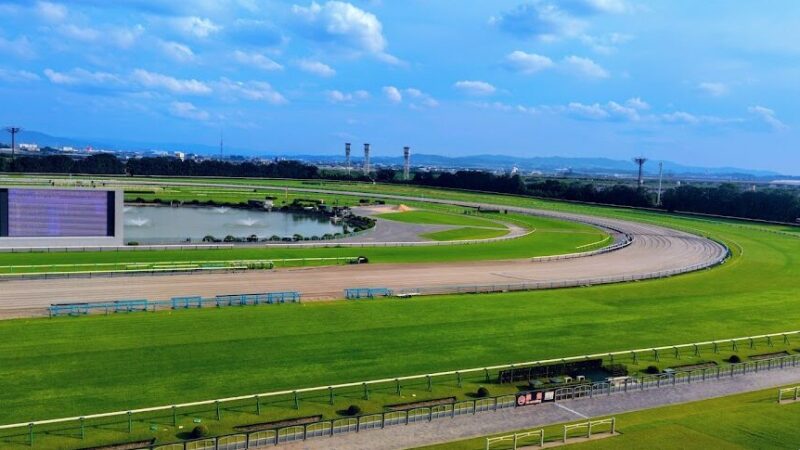
Course: You can view the actual racing course up close
Kyoto Racecourse Course Characteristics and Their Recreation in Uma Musume
Basic Course Information
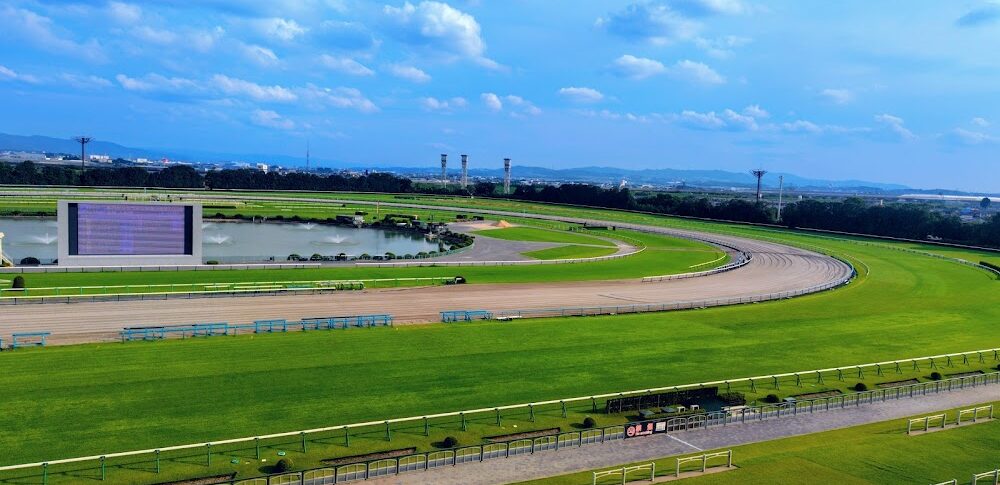
Kyoto Racecourse is a right-turning racecourse with two courses: an outer loop and an inner loop.
Outer loop course:
- One lap: 1,894m
- Straight distance: 404m
- Characteristics: Gentle curves requiring stamina
Inner loop course:
- One lap: 1,608m
- Straight distance: 328m
- Characteristics: Tight turns where speed is important
Characteristics of Kyoto Racecourse in-Game
In Uma Musume, the characteristics of Kyoto Racecourse are reflected as follows:
Distance variations: Wide range from short distance (1,200m) to long distance (3,200m)
Course aptitude: Characters with aptitude for right-turning courses have an advantage
Skills: The “Kyoto Race Course◯” skill improves performance in Kyoto races
Major Race Distances and Courses
Emperor’s Prize (Spring): Turf 3,200m (outer loop) – One of the most important races in-game
Chrysanthemum Prize: Turf 3,000m (outer loop) – Final leg of the Classic Triple Crown
Queen Elizabeth II Cup: Turf 2,200m (outer loop)
Mile Championship: Turf 1,600m (outer loop)
All of these races are implemented in the Uma Musume game, allowing for enjoyable race development based on actual racecourse characteristics.
Nearby Sacred Pilgrimage Spots
Sacred Sites in Kyoto
Uma Musume features locations beyond Kyoto Racecourse within Kyoto Prefecture.
Sannenzaka (Sannen-zaka) Area: Appears in the anime as a Kyoto sightseeing scene. The historic stone-paved slope leading to Kiyomizu Temple, where the characters are depicted strolling. Yodo Station is approximately 30 minutes by Keihan Railway from downtown Kyoto.
Kyoto Streetscape: In the work, traditional Kyoto townhouses and temples appear as backgrounds, creating a Kyoto atmosphere.
Sacred Sites in Shiga Prefecture
Mikarino-mori Kamo Shrine: A shrine known as a sacred site pilgrimage spot for Uma Musume. Located relatively close to Kyoto Racecourse, many fans visit it together with the racecourse.
Other Racecourses in the Kansai Region
Hanshin Racecourse: Located in Takarazuka, Hyogo Prefecture, and alongside Kyoto Racecourse is a major racing venue in Kansai. Many important races like the Takarazuka Memorial and Sakura Flower Prize are held there and appear extensively in Uma Musume. Approximately one hour by train from Kyoto Racecourse.
Necessary Items and Preparations for Sacred Site Pilgrimage
Essential Items
Camera/Smartphone: For recording sacred site photos
Charger/Mobile battery: Important as battery is consumed during photography and information searches
Maps/Apps: Navigation apps such as Google Maps
Beverages: Particularly important for hydration on summer race days
Useful Items
Work materials: Saving anime screenshots or game screens makes comparison easier
Binoculars: For viewing the entire course during race watching
Hat/Sunscreen: To prepare for extended outdoor time
Leisure sheet: Convenient for watching races on grassy areas
Admission Information for Race Days
Admission fee: 200 yen (Free for those under 15)
Opening time: Usually around 9:00 AM (varies by race)
Special viewing seats: Some paid seats require advance reservation
Etiquette and Precautions
Photography Etiquette
- Consideration for other visitors: Be careful not to obstruct passage
- Respect facility rules: Do not photograph in prohibited areas
- Avoid loud conversations: Especially during races, keep quiet
- Tripod use: Use restraint during crowded times, or switch to handheld shooting
Racecourse Etiquette
Betting lines: Line up neatly during crowded times
Trash disposal: Discard in designated bins with proper sorting
Smoking: Only in designated smoking areas
Drinking: Avoid excessive alcohol and refrain from inconveniencing others
Mindset as a Sacred Site Pilgrim
The racecourse is fundamentally a facility for enjoying racing. Even when visiting for sacred site pilgrimage, it is important to be considerate of racing fans and general visitors, and to respect the facility. Be aware that your conduct as a Uma Musume fan also affects the work’s image.
How to Enjoy Uma Musume and Actual Racing
Differences Between Game and Real Racing
While Uma Musume’s game is based on actual racing, it also includes many game-specific productions and settings. By visiting an actual racecourse, you can more deeply understand the excitement of races depicted in-game and the atmosphere of the racecourse.
First-Time Race Watching
For those who became interested in racing through Uma Musume, the following points are recommended:
Paddock viewing: A rare opportunity to see horses up close before the race
Race watching: Experience the thrill of actual races from the stands
In-course announcements: Experience the excitement of commentary that is also recreated in-game
Display corners: Learn about racing history and famous horses
Betting on Races
Some Uma Musume fans enjoy the experience of placing bets on descendants of horses that were models for characters in the work, or related horses. However, it is important to understand that racing is a form of gambling for those 20 and over, and to enjoy it within appropriate limits.
The History of Kyoto Racecourse and Uma Musume
The Development of Kyoto Racecourse
Kyoto Racecourse was established in 1925 (Taisho 14) and is one of Japan’s historic racecourses. Positioned in Yodo, it is also called “Yodo Racecourse” and has developed as the center of Kansai racing.
From 2023, large-scale renovation work began, and the facility is being transformed into a more modern one. This renovation may create differences between the landscape depicted in Uma Musume and the actual landscape.
Historic Battles
Kyoto Racecourse has been the stage for numerous historic races. The famous horses that were models for characters appearing in Uma Musume also displayed races that have gone down in history at this venue.
Emperor’s Prize (Spring): The spring major determining the long-distance champion
Chrysanthemum Prize: A classic final race testing 3-year-old stamina over distance
Takarazuka Memorial: Once held in Kyoto as the spring grand prix (now at Hanshin)
Kyoto Racecourse’s Appeal by Season
Spring (March-May)
Major races: Emperor’s Prize (Spring), Kyoto Newspaper Cup
Climate: Mild and comfortable, ideal timing for sacred site pilgrimage
Cherry blossom season: Cherry blossoms can be enjoyed around the racecourse and along the Yodo Station passage
Summer (June-August)
Summer sees few race days at Kyoto Racecourse, with races held mainly at other venues. While non-race days are suitable for sacred site pilgrimage, Kyoto’s summers are hot and humid, requiring heat stroke precautions.
Autumn (September-November)
Major races: Chrysanthemum Prize, Queen Elizabeth II Cup, Mile Championship
Climate: Refreshing weather ideal for race watching
Autumn foliage: In November, you can also enjoy surrounding autumn leaves
Winter (December-February)
Major races: Hanshin JF (Hanshin races) followed by year-end/New Year closure
Climate: Cold weather precautions necessary, but relatively less crowded
Racing Venue Strategies for Uma Musume Fans
Checking Event Information
The JRA official website publishes information about various events held at the racecourse. Uma Musume collaboration events may be held, so checking before your visit is recommended.
Merchandise Purchase
Gift shops within the racecourse sell racing-related goods and souvenirs. Uma Musume collaboration merchandise may be sold, making it a must-see point for fans.
Dining Facilities
Multiple restaurants and concession stands within Kyoto Racecourse allow you to enjoy meals while watching races. Kyoto-specific cuisine is also available.
Dining and Sightseeing Spots Near Yodo Station
Restaurants Near Yodo Station
There are several restaurants near Yodo Station where you can stop before or after races. Reflecting on sacred site pilgrimage memories at local restaurants or cafes is also recommended.
Yodo Castle Ruins Park
A historical spot within walking distance of Yodo Station. A tourism destination you can visit before or after your racecourse visit.
Travel to Downtown Kyoto
From Yodo Station, the Keihan Railway reaches downtown Kyoto in approximately 20-30 minutes. You can also enjoy Kyoto sightseeing after your sacred site pilgrimage.
Summary: The Charm of Kyoto Racecourse and Yodo Station Passage Pilgrimage
As a sacred site for Uma Musume Pretty Derby, Kyoto Racecourse and Yodo Station passage are precious spots where you can experience the work’s world. By actually seeing the atmosphere of the real racecourse, the excitement of races, and the landscapes that appeared in the work, your understanding and affection for the work will deepen further.
By visiting on a race day, you can taste the thrill of races experienced in-game in reality, and even on non-race days, you can quietly enjoy the pilgrimage’s atmosphere. The convenient access from Keihan Yodo Station is also appealing, making it an ideal location for first-time sacred site pilgrimages.
While the racecourse’s renovation work may change the landscape, that too will become part of the new Kyoto Racecourse’s history. As an Uma Musume fan and racing fan, enjoy sacred site pilgrimage while following etiquette, and discover the charm of both the work and real racing.
As you walk through the Yodo Station passage and pass through the racecourse gates, you will be able to see the same landscape as the Uma Musume characters. That experience will become a precious memory that allows you to enjoy the game and anime even more deeply.