From Tomorrow, the World Will Be Painted: Nagasaki Prefecture Sacred Site Pilgrimage Complete Guide
“From Tomorrow, the World Will Be Painted,” an original anime produced by P.A.WORKS that aired in fall 2018. Set in a slightly mysterious world where magic still exists, the story follows Tsukushiro Hitomi, a girl who has lost her color perception, as she time-slips to Nagasaki 60 years in the past and grows through encounters with her photography club friends.
The greatest charm of this work is that the beautiful scenery of Nagasaki is depicted carefully down to the finest details. The production staff spent several days conducting location research in Nagasaki City and faithfully recreated real places. This article comprehensively covers all the spots featured in the anime, from efficient model courses for pilgrimage to photography tips, providing thorough explanations of all information necessary for sacred site pilgrimage.
“From Tomorrow, the World Will Be Painted” Overview
“From Tomorrow, the World Will Be Painted” is a youth fantasy anime set in Nagasaki. The protagonist, Tsukushiro Hitomi, is a second-year high school student who lost the ability to see colors in her childhood. Through magic from her grandmother, Tsukushiro Kohaku, she time-slips from 2078 to Nagasaki in 2018.
In Nagasaki 60 years in the past, she meets Aoi Yuisho, Kawai Kurumi, Yamabuki Shota, and a young version of Kohaku, all members of the photography club. When Hitomi touches the paintings drawn by Yuisho, she is able to perceive “color” for the first time. Through interactions with her photography club friends, Hitomi gradually opens her heart and recovers the colors she had lost.
Nagasaki City, the setting of the story, is a slope-filled town brimming with exotic charm. Numerous real tourist attractions such as Glover Garden, Oranda Slope, and Nagasaki Waterfront Forest Park appear in the anime, creating a mysterious world where small magic remains in everyday life.
Preparation for Sacred Site Pilgrimage and Basic Information
Access Methods
The main access methods to Nagasaki City are as follows:
Airplane
- From Nagasaki Airport to Nagasaki Station: About 45 minutes by limousine bus
- Direct flights available from major cities to Nagasaki Airport
JR
- From Hakata Station to Nagasaki Station: About 2 hours by limited express “Kamome”
- If using the Shinkansen, transfer at Takeo Onsen Station
Highway Bus
- Direct routes available from Fukuoka, Kumamoto, Sasebo, and other cities
Transportation Within the City
The streetcar is extremely convenient for sacred site pilgrimage within Nagasaki City. At 130 yen per ride, purchasing a one-day pass (600 yen) allows unlimited boarding. Most major sacred sites are within walking distance of streetcar stops.
As there are many steep slopes in some areas, comfortable shoes are essential. For access to elevated areas like Nabewari-yama Observatory, you can also use inclined elevators such as Glover Sky Road.
Best Seasons for Pilgrimage
While the anime beautifully depicts autumn Nagasaki, sacred site pilgrimage can be enjoyed year-round.
- Spring (March-May): Cherry blossom season, pleasant climate
- Autumn (September-November): Same season as the anime, fall foliage also enjoyable
- Winter (December-February): Most beautiful time for night views
- Summer (June-August): Protective measures against heat necessary, but lush green scenery is beautiful
Sacred Site Pilgrimage Model Courses
Waterfront Forest Park to Higashiyamate Course (Approximately 3 hours)
This course efficiently covers spots that frequently appear from the early to mid-parts of the anime.
Start: Shinchi Chinatown Streetcar Stop
Nagasaki Waterfront Forest Park
The place where Hitomi and Yuisho first meet, this park is where numerous important scenes are filmed. A spacious area along the seashore with a view of the Megami Bridge across the water.
In episode 1, immediately after Hitomi arrives in Nagasaki in 2018, she walks hesitantly along the promenade of this park. The scene where she sits on a bench overlooking the sea appears again in episodes 3 and 8. The scenery at twilight especially captures the anime’s atmosphere perfectly.
Photography Points: Seaside promenade, benches and surrounding areas, compositions overlooking the Megami Bridge from the lawn
Oranda Bridge
A small bridge near Shinchi Chinatown Streetcar Stop where Hitomi and Yuisho have a conversation. It still retains its original appearance, and the bridge railings and surrounding buildings match the anime.
Higashiyamate Kōjūsan-bankan
An area of Meiji-era Western-style buildings in the Higashiyamate district. The Kōjūsan-bankan is a historical structure that can actually be visited. In the anime, its exterior is carefully depicted, appearing as a symbol of Nagasaki’s exotic charm.
The building’s interior is free to view with exhibits recreating life from that era. The slope in front of the building is also a popular photography spot.
Hours: 9:00-17:00
Closed: Year-end and New Year holidays
Oranda Slope
One of Nagasaki’s most representative tourist attractions, appearing multiple times in the anime. The stone-paved slope with Western-style buildings on both sides is beautiful, depicted as a path the characters use after school. Episode 5 features Hitomi and Kurumi having a conversation while walking; episode 9 shows the photography club members gathering there. The time of day when evening light filters in is particularly good for taking photos matching the anime’s atmosphere.
Goal: Ishibashi Streetcar Stop
Minami-Yamate to Nabewari-yama Course (Approximately 4 hours)
A course covering touching spots with numerous climactic anime scenes.
Start: Ishibashi Streetcar Stop
Glover Sky Road
A 160-meter inclined elevator that easily transports you up the steep slopes of Minami-Yamate. Episode 4 features Hitomi and Yuisho riding it, with the glass-enclosed car offering beautifully depicted views of Nagasaki’s townscape.
Free to use and part of local daily life. The view from inside the elevator is also a photography point.
Operating Hours: 6:00-23:00
Glover Garden
A representative tourist attraction of Nagasaki that becomes an important stage in the anime. A vast garden dotted with Meiji-era Western buildings, including the nationally designated important cultural property Glover Mansion.
Episode 10 features an unforgettable scene where Hitomi and Yuisho visit together alone. The view of Nagasaki Harbor from the garden’s observation platform, the stone pavement in front of the building, the flower beds—all are faithfully recreated down to detail.
The terrace in front of the former Glover residence is especially must-see. You can photograph the same composition as in the anime.
Operating Hours: 8:00-18:00 (varies by season)
Admission: 620 yen for adults
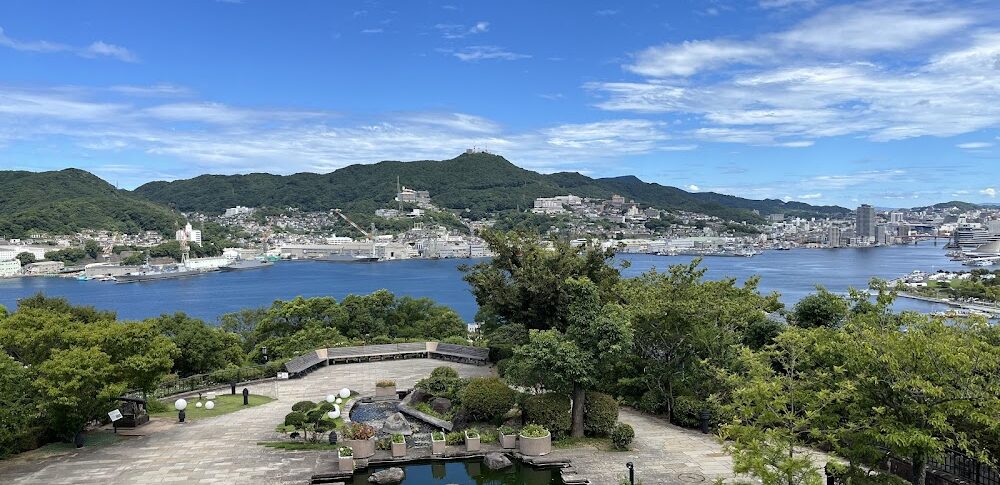
Ōura Observation Park
A small park on the hilltop of Minami-Yamate offering panoramic views of Nagasaki Harbor. In episode 7, Hitomi visits alone and confronts her own feelings. The composition of sitting on a bench gazing at the sea is one of the anime’s important motifs. Few tourists visit, allowing quiet enjoyment of the scenery. The time at dusk is particularly beautiful, strongly evoking the anime’s atmosphere.
Kinen-zaka
A stone-paved slope encountered on the way from Glover Garden to Nabewari-yama Observatory. A quiet road through residential areas, it appears multiple times as a path the characters daily walk. The view of Nagasaki’s townscape and sea from partway up the slope is beautiful, with photography points scattered throughout where you’ll want to stop and shoot.
Nabewari-yama Observatory
An observation platform offering sweeping views of Nagasaki’s night scene, one of the anime’s most crucial spots. The final episode’s climactic scene where Hitomi and Yuisho reunite takes place here.
From this 169-meter elevation platform, you can see Nagasaki Harbor, Inasa Mountain, and the city center in a 360-degree view. The night view in particular is stunning, referred to as Nagasaki’s “10 million dollar night view,” and the anime’s night scenes are impressively depicted. This spot is the highlight of the sacred site pilgrimage.
Access the observatory by bus from Ishibashi Stop or on foot (about 30 minutes, quite steep).
Access: About 10 minutes by bus from Ishibashi bus stop, 5-minute walk from observatory entrance
Goal: Ishibashi Streetcar Stop
Ishibashi to Izumo Nearby Park Course (Approximately 2.5 hours)
A course covering the area where photography club activities and daily scenes frequently appear.
Izumo Nearby Park
Appears frequently as a place where photography club members gather for photo shoots and after-school meetups. Episode 6’s photography shooting scene is particularly impressive.
A quiet park in a residential neighborhood where playground equipment and benches remain in the same configuration as in the anime. Though an ordinary park where local children play, it’s an important spot for sacred site pilgrims.
Nagasaki Minami High School Surroundings
The model for the high school where the characters study with a magical science program. The actual Nagasaki Minami High School is naturally off-limits to the public, but its exterior and surroundings can be seen in the anime.
During school festivals, limited public access is sometimes available, offering a rare opportunity to enter the campus. However, at other times, photography should be limited to outside the grounds, taking care not to inconvenience students and neighbors.
Forest Witch Cafe
The “Forest Witch Cafe” run by Hitomi’s grandmother Tsukushiro Kohaku is an important base in the story. While no specific real-location model has been identified, multiple Nagasaki cafes are believed to have served as inspiration.
In the anime, it’s depicted as a cottage cafe surrounded by forest with warm interior design and Kohaku’s homemade sweets. It’s also where the magic sending Hitomi from the present to the past is activated.
Nagasaki has numerous atmospheric old-house cafes and retro tearooms scattered throughout, making them recommended rest stops during pilgrimage.
Other Important Spots
Nagasaki Penguin Aquarium
In episode 2, the photography club members visit this aquarium for shooting. The real Nagasaki Penguin Aquarium serves as the model, with the interior displays and penguin behavior faithfully recreated.
Particularly moving is seeing the penguins swimming in natural ocean scenes—a rare experience even in Japan.
Operating Hours: 9:00-17:00
Admission: 520 yen for adults
Access: About 30 minutes by bus from Nagasaki Station
Iō Island
An important setting in episode 11. About 30 minutes by boat from Nagasaki Harbor, the island features beautiful coastlines and a church.
In the anime, Hitomi and Yuisho visit together, with the important conversation they have depicted as a crucial moment. The lighthouse area’s scenery is impressively shown. Day trips are possible with resort facilities well-developed.
Access: About 19 minutes by fast ferry from Nagasaki Harbor, or accessible by car via bridge
Shinchi Chinatown
One of Japan’s three major Chinatowns, featured in episode 4 when the photography club visits. The sight of colorful Chinese restaurants is beautifully depicted from Hitomi’s perspective as she regains her color vision.
Ideal as a lunch or dinner break spot. You can enjoy Nagasaki specialties like champon and sara udon.
Spectacles Bridge
Japan’s oldest arched stone bridge and a famous Nagasaki tourist attraction. In the anime, it appears as a background where the characters use it as a school route.
The reflection in the water resembles eyeglasses, hence the name. Finding heart-shaped stones is also part of the tourist experience.
Complete Night View Spot Guide
In “From Tomorrow, the World Will Be Painted,” Nagasaki’s beautiful night views are depicted as important story elements.
Inasa Mountain Observatory
Counted among the world’s three new best night views, it’s representative of Nagasaki’s night scenery. While not directly featured in the anime, it’s referenced in scenes observing Nagasaki’s night view overview.
From the 333-meter elevation observatory, you have 360-degree views of Nagasaki’s harbor, city, and surrounding area. Access is by ropeway, with particularly heavy crowding from sunset onwards.
Operating Hours: 9:00-22:00
Ropeway Fare: 1,250 yen round-trip
Nabewari-yama Observatory (Night View)
As previously mentioned, the setting of the final episode’s crucial scene. Closer to the city than Inasa Mountain, it offers more immediate night views.
The observatory is open 24 hours, freely accessible even at night. However, limited nighttime lighting makes carrying a flashlight recommended.
Glover Garden (Night Viewing Period)
Night viewing is held during specific periods, allowing simultaneous enjoyment of illuminated Western buildings and Nagasaki’s night view. This offers the experience closest to the anime’s fantastical atmosphere.
Photography Tips and Etiquette
Comparative Photography Points
The essence of sacred site pilgrimage is comparing anime scenes with actual landscapes. Saving anime screenshots on your smartphone or tablet and searching for matching angles on-location is efficient.
- Match the time of day: Visiting when the anime scene takes place makes lighting match better
- Consider season: Since the anime is set in autumn, visiting September-November brings landscapes closer to the anime
- Camera height: The anime’s camera angles are typically slightly lower than eye level
Monochrome Photography Appeal
To experience Hitomi’s perspective, many fans photograph some scenes in black and white. Comparing color and monochrome versions allows deeper appreciation of the anime’s worldview.
Pilgrimage Etiquette
- Don’t trespass on private property: Special care needed around schools
- Be quiet in residential areas: Avoid loud conversation and early morning or late night visits
- Follow traffic rules: Don’t become so absorbed in photography you ignore safety
- Take all trash with you: Keeping sacred sites beautiful is key to sustainable pilgrimage
Nagasaki Cuisine and Souvenirs
Cuisine to Enjoy During Pilgrimage Breaks
Champon and Sara Udon
Representative Nagasaki noodle dishes. Enjoy authentic flavors at Shinchi Chinatown and city restaurants.
Castella
Nagasaki’s signature confection. Many long-established shops like Bunmeido and Fukusaya exist.
Toruko Rice
Nagasaki-origin Western cuisine with pilaf, spaghetti, and pork cutlet served on one plate—a hearty dish.
Milk Shake
In Nagasaki, served not as a drink but as a sherbet-like sweet.
Recommended Souvenirs
- “From Tomorrow, the World Will Be Painted” Related Goods: Available at some bookstores and tourist information centers in Nagasaki City
- Nagasaki Castella: A classic but essential choice
- Yoriyori: Deep-fried sweets from Chinatown
- Nagasaki Champon (Souvenir Packs): Enjoy Nagasaki’s flavor at home
Accommodation and Access Information
Recommended Accommodation Areas
Nagasaki Station Vicinity
Excellent transportation, abundant hotel options from business hotels to luxury properties. Convenient streetcar and bus access.
Shian Bridge and Doza Area
Close to entertainment districts with abundant dining. Walking distance to tourist spots.
Inasa Mountain Area
Recommended for night view enthusiasts. Quiet environment for relaxation.
Convenient One-Day Passes
Streetcar One-Day Pass: 600 yen
Unlimited streetcar rides covering virtually all major sacred sites.
Nagasaki City Tourism One-Day Pass: 800 yen
Streetcar plus limited bus route access.
Seasonal Highlights
Spring (March-May)
Cherry blossom season makes Glover Garden and Izumo Nearby Park especially beautiful. While not depicted in the anime, cherry blossoms and fresh greenery offer striking contrast.
Summer (June-August)
Nagasaki Peiron Boat Race Championships (July) and Shōryō Nagashi (August 15) are Nagasaki-specific events. Heat management essential, but experience vibrant Nagasaki.
Autumn (September-November)
The anime’s season and most suitable for pilgrimage. Nagasaki Kunchi (October 7-9), Nagasaki’s largest festival, makes this period especially lively. Fall foliage is beautiful, ideal for photography.
Winter (December-February)
Night views are most beautiful. Clear air makes views from Nabewari-yama and Inasa exceptional. The Nagasaki Lantern Festival (lunar new year period) offers magical Chinatown illumination.
Conclusion: A Journey Through the Painted World
The “From Tomorrow, the World Will Be Painted” sacred site pilgrimage is not merely visiting the anime’s settings but deeply knowing Nagasaki as a city. Just as Hitomi regained her colors, each visitor can discover new colors in Nagasaki’s beautiful landscapes.
Slope-filled streets, exotic charm, beautiful night views, warm people—Nagasaki overflows with reasons for being this story’s stage. Using this article’s featured spots and model courses, plan your own unique sacred site pilgrimage journey.
Walking Nagasaki’s streets while recalling anime scenes will surely leave your heart painted with vibrant memories. Retrace the path Hitomi and Yuisho walked, visit places the photography club frequented, and embark on this special journey through the “painted world.”