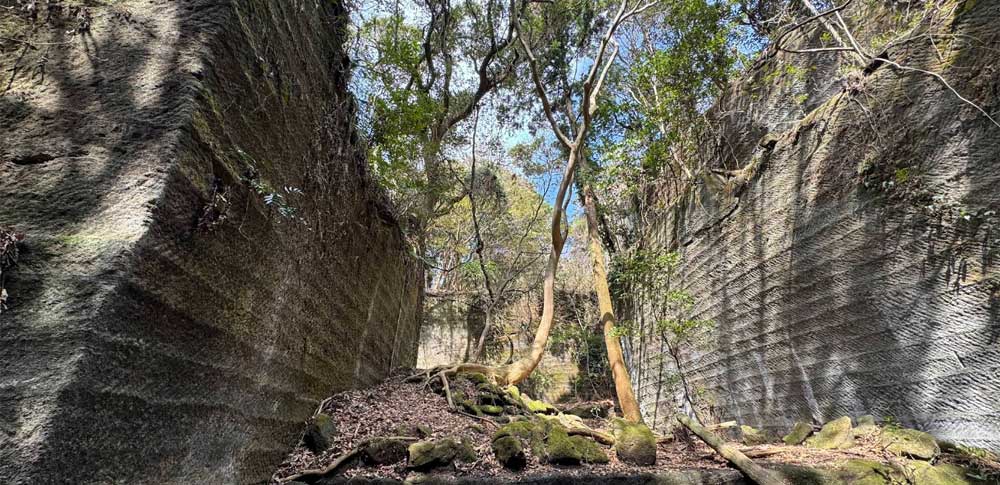
The stone quarry ruins at Nokogiriyama in Chiba Prefecture have recently garnered attention as a spectacular viewpoint that evokes the worldview of Studio Ghibli’s masterpiece “Castle in the Sky.” The vertically hewn massive rock walls and lush vegetation sprouting from the crevices are reminiscent of the fantastical world where Pazu and Sheeta embarked on their adventure. This article provides a comprehensive explanation of this mystical place known as the “Laputa Wall,” covering everything from access methods and historical background to photography spots and nearby attractions.
About Nokogiriyama Stone Quarry Ruins “Laputa Wall”
A Spectacular View Reminiscent of Castle in the Sky
Nokogiriyama is a mountain with an elevation of 329.4 meters spanning across Kyonan Town and Futtsu City in Awa District, Chiba Prefecture. Among the stone quarry ruins scattered on the north slope of this mountain, the place known especially as the “Laputa Wall” is characterized by a vertical rock wall reaching a height of approximately 96 meters.
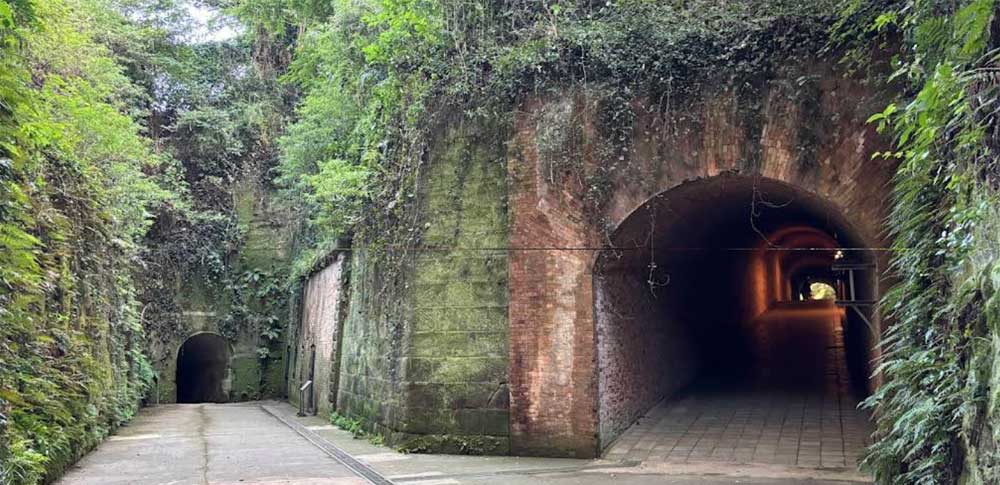
The rock wall, which was vertically excavated to extract stone materials, has merged with nature over time, with vegetation growing through the crevices and moss covering its surface. This unique landscape, reminiscent of the ancient ruins depicted in director Hayao Miyazaki’s “Castle in the Sky,” eventually earned it the affectionate nickname “Laputa Wall.”
Industrial Heritage Born from Boshu Stone Quarrying
The stone quarry ruins of Nokogiriyama are not merely a tourist destination but also valuable industrial heritage that tells the history of Japan’s stone material industry. The “Boshu stone” excavated in this area is a type of tuff known for its ease of processing and excellent fire resistance, making it a high-quality stone material.
From the Edo period until the 1980s, excavation continued for approximately 300 years, with the stone being used in many historical structures including Edo Castle, Yasukuni Shrine, and Waseda University buildings. Quarrying was primarily performed by hand, with stoneworkers using traditional methods of splitting rock by driving in wedges called “arrows.”
The vertical rock walls visible today possess a beauty reminiscent of a massive sculpture, created as a result of digging deeper and deeper in search of quality stone materials, producing a tapestry of horizontal tunnels and excavation surfaces.
Access Methods to Laputa Wall
Nearest Station and Access Routes
By Train
- 8-minute walk from JR Uchibo Line “Hamakanaiya Station” to Nokogiriyama Ropeway base station
- Approximately 2 hours from Tokyo Station to Hamakanaiya Station by express train
- Approximately 1 hour 30 minutes from Chiba Station to Hamakanaiya Station
By Car
- Approximately 5 minutes from “Futtsu-Kanaya IC” on Tateyama Expressway
- Approximately 1 hour 30 minutes from central Tokyo via Tokyo Bay Aqua Line
- Free parking available at Nokogiriyama Ropeway base station (approximately 200 spaces)
- It’s also possible to drive near the mountaintop using the Nokogiriyama mountain road toll route
Ropeway and Hiking Routes
Nokogiriyama Ropeway
- Operating hours: 9:00–17:00 (varies by season)
- Time required: Approximately 4 minutes one way
- Fares: Adults ¥950 round trip, ¥500 one way
- Approximately 30–40 minutes walk from the mountain top station to “Laputa Wall”
Hiking Routes
There are multiple routes to Laputa Wall:
- Sharikidō Course (Shortest Route)
- Time required: Approximately 40 minutes one way
- Difficulty: Elementary to intermediate
- Direct access to hiking trail from Hamakanaiya Station
- Relatively gentle and easy to walk
- Route via Kangetsu Observation Point
- Time required: Approximately 50 minutes one way
- Difficulty: Intermediate
- Passes through Nihon-ji Temple grounds from the ropeway mountain top station
- Can also enjoy other attractions like Jigoku no Nozoki
- Kanto Friendship Trail Route
- Time required: Approximately 1 hour one way
- Difficulty: Intermediate to advanced
- For those who want to enjoy full-scale hiking
Attractions and Photography Spots at Laputa Wall
Main Photography Spots
Views from the Observation Deck
An observation deck is installed in front of Laputa Wall for safely enjoying the scenery. From here, one can look up at the 96-meter vertical rock wall directly and experience its overwhelming scale.
Countless traces of “arrow holes” left from the quarrying period remain on the rock wall surface, allowing visitors to observe the handwork of past stonemasons. On sunny mornings, the entire wall is illuminated, revealing the stone’s texture and color distinctly, making it ideal for photography.
Compositions from Horizontal Caves
Several horizontal caves remain at the quarry site, excavated in pursuit of quality stone materials. When looking out from inside these caves, one can capture compositions that feel like viewing from inside an ancient ruin as depicted in “Castle in the Sky.”
The contrast between the cave’s darkness and outdoor brightness, the stone’s texture, and the landscape woven by visible greenery through the gaps are popular for Instagram-worthy photography. However, some areas have unstable footing, so exercise caution for safety during photography.
Changes in Appearance Throughout the Day
Early Morning (6:00–8:00)
During misty hours, one can enjoy a more fantastical atmosphere. The massive rock wall emerging through the mist resembles the scene where Laputa Castle appears from within clouds. However, poor visibility of the ground requires sufficient caution.
Morning (9:00–12:00)
Sunlight illuminates the entire rock wall, and Boshu stone’s characteristic whitish color appears beautifully. This is the most suitable time for photography. Tourist crowds are relatively small, allowing leisurely enjoyment of the scenery.
Afternoon (13:00–16:00)
Shadows appear on the rock wall, emphasizing its three-dimensional quality. The strong contrast between light and shadow allows dramatic photography. Weekend afternoons see increased tourist numbers.
Dusk (16:00–18:00)
The rock wall bathed in sunset takes on warm orange hues. As sunset approaches, the wall’s silhouette appears mystically. However, darkness follows sunset, so attention must be paid to descent timing.
Other Attractions at Nokogiriyama
History and Attractions of Nihon-ji Temple
Nihon-ji, an ancient temple believed to have been established in 725 by imperial decree of Emperor Shomu, is located on Nokogiriyama. Known as the oldest imperial temple in the Kanto region, the grounds contain numerous attractions.
Nihon-ji Great Buddha (Yakushi Rurikō Nyorai)
A Buddha statue carved into the cliff face with a height of 31.05 meters, it is one of Japan’s largest. More than twice the size of the Great Buddha in Kamakura (approximately 13.35 meters tall), its magnitude is awe-inspiring. In 1783, Hidenori Ōno and his 27 disciples spent three years carving it.
Once deteriorated through weathering, it was restored over 6 years in 1969 to its current form. As Japan’s largest seated Buddha and said to be larger than the Great Buddha in Nara, its significance is immense.
Jigoku no Nozoki (Hell’s Lookout)
An iconic spectacular spot of Nokogiriyama, this is a rock jutting out from a 100-meter cliff where one can stand and view a vast panorama of Tokyo Bay below. Those with acrophobia may find it challenging, but the view becomes a lifelong memory.
On clear days, one can view Yokohama, Kawasaki, Tokyo’s urban skyline across Tokyo Bay, and even Mount Fuji.
Hyakushaku Kannon
A Kannon statue approximately 30 meters high carved into the quarry rock wall. Created between 1960 and 1966 to honor those who died and perished in World War II and traffic accident victims, this statue maintains harmony between natural and artificial elements, conveying a solemn atmosphere. It represents an interesting example of quarry site utilization distinct from Laputa Wall.
Sengohyakurakan (1,500 Arhats)
Over 1,500 arhat statues are placed on cliff surfaces and within caves at the quarry site. Created from the late Edo period through the Meiji era by disciples, each statue has a unique expression. It is said that as one gazes upon these arhats, one will surely find a face resembling oneself or an acquaintance.
Tokyo Bay’s Spectacular Panoramic View
From near Nokogiriyama’s summit, one can enjoy 360-degree panoramic views. Beyond Tokyo Bay, one can see mountains of the Boso Peninsula, the Izu Peninsula, and on clear days, even Mount Fuji.
The view from the observation platform is particularly exceptional, with ships passing through Uraga Channel visible below, the Miura Peninsula and Yokohama’s Landmark Tower on the opposite shore, and even Tokyo Skytree visible in the distance. At dusk, the beautiful scenery of the sunset over Tokyo Bay and the lights of the opposite shore unfold.
Precautions and Preparations for Your Visit
Recommended Clothing and Belongings
Recommended Attire
- Easy-to-move-in clothing (long sleeves and pants recommended)
- Trekking shoes or non-slip sneakers
- Hat (sun protection)
- Rain wear (for weather changes)
- Seasonal outerwear (mountain summit temperatures are lower than lowlands)
Packing Checklist
- Drinking water (1 liter or more recommended)
- Light snacks or energy foods
- Towel
- Sunscreen
- Insect repellent spray (spring to autumn)
- Smartphone backup battery
- Coins (for admission fees and vending machines)
- Plastic bags (for trash disposal)
- Basic first aid kit
Safety Precautions
Precautions in Stone Quarry Area
The Laputa Wall area is a former quarry site with many unstable footing locations. Please observe the following:
- Never enter areas marked with barriers or no-entry signs
- Do not approach rock walls (risk of rockfall)
- Pay close attention to footing and overhead when entering horizontal caves
- Exercise extra caution after rain or on rainy days when surfaces are slippery
- Avoid solo travel; travel in groups when possible
Precautions During Hiking
- Stay on designated hiking trails
- Choose routes suited to your fitness level
- Plan with plenty of time (descend before sunset)
- If weather deteriorates, turn back without hesitation
- Maintain regular water intake to prevent heat stroke
Optimal Times to Visit
Spring (March–May)
A season with mild temperatures ideal for hiking. Fresh greenery is beautiful, and the contrast between rock wall and vegetation is vivid. Crowding is expected during Golden Week, so weekday visits are recommended.
Summer (June–August)
Vegetation is at its most lush, with an increasing jungle-like atmosphere. However, high temperatures and humidity make heat stroke prevention essential. Early morning visits are recommended. Be careful during rainy season as footing becomes slippery.
Autumn (September–November)
The most suitable season for visiting. Pleasant temperatures and fall foliage can be enjoyed. Particularly from late October to early November, the contrast between rock wall and autumn leaves is beautiful and ideal for photography. However, expect crowding in this popular season.
Winter (December–February)
A hidden gem season with fewer tourists where one can enjoy the scenery quietly. Clear air allows for distant views. However, low temperatures and early sunset make thermal management and time planning crucial.
Nearby Tourist Attractions and Cuisine
Gold Valley Port Area
Tokyo Bay Ferry
A ferry connecting Kanaya Port and Kurihama Port in Kanagawa Prefecture. The approximately 40-minute journey allows you to enjoy Tokyo Bay scenery while viewing Nokogiriyama from the sea. Since vehicles can be loaded, combined tourist plans with the Miura Peninsula and Yokosuka are popular.
The Fish
A complex facility near Kanaya Port with a market selling fresh seafood, restaurants, and an observation deck. You can enjoy dishes made with Boso region seafood while shopping for souvenirs. The observation deck offers views of Tokyo Bay and Nokogiriyama.
Boso Region Seafood Cuisine
Local Fish Dishes
Restaurants around Nokogiriyama offer dishes made with fresh fish caught in Tokyo Bay. “Horse mackerel namero” (minced horse mackerel), “horse mackerel fries,” and “seafood rice bowls” are particularly popular. Many restaurants are found near Hamakanaiya and Yasuda stations.
Boshu Loquat
Kyonan Town is famous as a loquat-growing region. The season runs from late May to early June, when fresh loquats can be purchased at direct sales shops and roadside stations. Sweets and jams made with loquat are also popular.
Iso-Ryori (Seaside Cuisine)
Along the Boso Peninsula coastline, many restaurants serve seafood-based seaside cuisine. You can enjoy luxurious seafood including turban shell tsubo-yaki, spiny lobster (autumn–spring), and abalone.
The Relationship Between Laputa Wall and Castle in the Sky
Official Connections
Importantly, the Nokogiriyama stone quarry ruins called “Laputa Wall” have not been officially acknowledged by Studio Ghibli or director Hayao Miyazaki as a model location for “Castle in the Sky.” Rather, because its landscape resembles the film’s worldview, visitors began calling it “just like Laputa,” and the nickname “Laputa Wall” eventually became established.
Studio Ghibli generally maintains a policy of not explicitly stating whether locations are settings or models for their works. This reflects the production team’s intention to allow viewers to freely expand their imagination.
Why It Resembles Laputa
Atmosphere of Ancient Civilization Ruins
The Laputa Castle depicted in “Castle in the Sky” is a massive sky-city left by an advanced ancient civilization. Stone structures covered in greenery that convey the passage of time share many similarities with Nokogiriyama’s quarry ruins.
Vertically hewn rock walls, regularly spaced arrow hole marks, light streaming through horizontal caves, and vegetation growing from rock crevices—these elements combine to create a mystical landscape where human creation and nature have merged.
Nature’s Return After Human Intervention
In the film, Laputa Castle is portrayed as a once-flourishing civilization that has gradually returned to nature after its decline. Nokogiriyama’s quarry site similarly shows nature reclaiming a place abandoned decades ago as quarrying ceased, perfectly aligning with this worldview.
Verticality and Openness
One impressive aspect of the film is the giant walls and structures of Laputa Castle. Nokogiriyama’s quarry ruins similarly evoke the grandeur of Laputa with their overwhelming scale provided by the 96-meter vertical rock wall.
As a Sacred Site for Ghibli Fans
Despite the absence of official connections, “Laputa Wall” is recognized among Ghibli fans as one of several “sacred sites.” Many who have actually visited report experiencing the sensation of entering the film’s world, sharing these experiences on social media.
However, when visiting, please keep the following in mind:
- Understand that this is not an officially designated Ghibli sacred site
- Show consideration for locals and other visitors
- Respect natural environments and historical sites
- Exercise appropriate conduct
History and Cultural Value of Boshu Stone
History of Boshu Stone Quarrying
Boshu stone quarrying began in earnest in the 17th century during the Edo period. The tuff found at Nokogiriyama was highly valued as a building material due to its ease of processing and excellent fire and water resistance.
Edo Period Prosperity
During the Edo period, vast quantities of Boshu stone were used in Edo Castle’s stone walls, samurai residences, and religious buildings. Stone shipped from Kanaya Port to Edo greatly contributed to the city’s construction. During this era, many stonemasons gathered around Nokogiriyama, and the stone industry flourished.
Development in Meiji, Taisho, and Showa Eras
From the Meiji era onward, as modern architectural demand increased, Boshu stone quarrying expanded. It was used in military facilities in Yokosuka, government buildings in Tokyo, university structures, and many other important buildings.
Quarrying techniques also evolved, with machinery supplementing hand labor. However, the traditional method using “arrows” remained the primary technique, with skilled stoneworkers’ techniques passed down through generations.
Late Showa Period Decline
From the 1950s onward, the demand for stone declined as concrete became widespread, and quarrying gradually shrank. Around 1985, most quarry sites closed, ending approximately 300 years of Boshu stone quarrying history.
Structures Built with Boshu Stone
Historical structures using Boshu stone remain in various locations:
- Yasukuni Shrine: Used in stone walls and stone steps
- Waseda University: Multiple buildings including Okuma Auditorium
- Yokosuka Naval Facilities: Docks, warehouses, etc.
- Edo Castle: Portions of stone walls
- Zojoji: Stone steps and stone walls
- Kamakura Temples and Shrines: Stone steps, stone walls, etc.
These structures demonstrate Boshu stone’s durability, maintaining their original appearance over 100 years later.
Value as Industrial Heritage
The Nokogiriyama quarry ruins are valuable industrial heritage conveying the history of Japan’s stone material industry. Arrow holes remaining in vertical walls, horizontal caves excavated for quarrying, and traces of transport routes all tell of quarrying techniques and labor practices from that era.
In recent years, the value as industrial heritage has been reassessed, with preservation and utilization initiatives emerging. Beyond its value as a tourist resource, it holds high educational value as a place to learn about local history and culture.
Annual Events in the Nokogiriyama Area
Major Events at Nihon-ji
First Sunrise (January 1)
The first sunrise from Nokogiriyama’s summit is a popular spot in the Boso Peninsula. On New Year’s Day, Nihon-ji opens its gates early, welcoming many worshippers. The first sunrise rising from Tokyo Bay is particularly beautiful.
Setsubun Festival (Around February 3)
A traditional Setsubun festival held at Nihon-ji. Bean-throwing and sacred fire rituals are performed to pray for good health throughout the year.
Flower Festival (April 8)
A Buddhist festival celebrating Buddha’s birth. A religious service is held in front of the Nihon-ji Great Buddha.
Kannon Festival (Mid-July)
A memorial service held in front of Hyakushaku Kannon. Religious services pray for traffic safety and world peace.
Local Events
Yasuda Yoritomo Cherry Blossom Festival (Mid-February–Early March)
An event celebrating early-blooming Kawazu cherry blossoms along Yasuda River in Kyonan Town. Approximately 600 cherry trees line the river, allowing one to experience an early arrival of spring.
Kyonan Raku Market (November)
A regional festival selling local agricultural products, seafood, and processed goods. Enjoy Boshu loquat, dried fish, and local cuisine.
Photography Etiquette and Social Media Posting Guidelines
Photography Etiquette
“Laputa Wall” is a popular photography spot, but please observe the following etiquette:
Consideration for Other Visitors
- Avoid occupying a location for extended periods
- Keep conversations and noise levels low
- Be mindful that others appear in your photos
- Respect waiting line rules
Safety Considerations
- Avoid photographing in dangerous locations
- Confirm surrounding safety before using selfie sticks
- Never walk backward while taking photos
- Never attempt dangerous activities like climbing walls
Environmental Consideration
- Always take trash with you
- Do not trample vegetation
- Do not deface rocks with graffiti
- Refrain from actions that damage nature
Social Media Posting Guidelines
Location Information Handling
Use caution when publicly sharing precise location information. Excessive tourism can lead to environmental destruction and inconvenience to residents.
Prevention of Misinformation
Avoid posting false information such as “Ghibli’s official sacred site.” The appropriate description is “a place that resembles Laputa’s worldview.”
Copyright Consideration
Using Ghibli works’ images or characters without permission constitutes copyright infringement. Use only photos you’ve taken yourself.
Conclusion: Experience a Non-Everyday Adventure at Laputa Wall
The stone quarry ruins “Laputa Wall” at Nokogiriyama in Chiba Prefecture is a unique spot where the magnificent landscape created by Boshu stone quarrying history and the worldview of “Castle in the Sky” overlap.
The 96-meter vertical rock wall, mystical horizontal caves, and vegetation sprouting from rock crevices weave a scenery that seems unbelievable for a location less than two hours from central Tokyo. Its historical value as industrial heritage, natural beauty, and the unique atmosphere of experiencing a film’s worldview continue to captivate many.
When visiting, take full safety precautions and follow etiquette while savoring this special place’s attractions to the fullest. The rock wall carved by sweating stonemasons of old, now merged with nature over time and generating new value—feel the drama of this history and explore Nokogiriyama with the adventurous spirit of Pazu and Sheeta.
Along with Tokyo Bay’s spectacular views, Nihon-ji’s historical structures, and the Boso region’s delicious cuisine, your special experience at “Laputa Wall” will surely become an unforgettable memory.