
【Uma Musume Pretty Derby】Tokyo Racecourse Main Gate Passage Sacred Site Pilgrimage Guide
Introduction: Uma Musume and Tokyo Racecourse Main Gate Passage
“Uma Musume Pretty Derby” is a mixed media content featuring personified versions of real racehorses as characters. In the anime adaptation, actual racecourses and surrounding facilities are faithfully reproduced, offering fans the true pleasure of sacred site pilgrimage.
The main gate passage to Tokyo Racecourse appears in numerous memorable scenes in Season 1 of the anime, including the scene where Special Week visits a racecourse for the first time and scenes of Uma Musume heading to training on a daily basis. This passage, which connects from Fuchu Racecourse Main Gate Station to Tokyo Racecourse, is an important sacred site spot where you can experience the world of the work.
This article comprehensively covers the detailed access methods to Tokyo Racecourse Main Gate Passage, scenes from the anime, photography points, and precautions for visiting—all the information necessary for a sacred site pilgrimage.
About Uma Musume Pretty Derby
Work Overview
“Uma Musume Pretty Derby” is a mixed media project developed by Cygames. Real famous racehorses are personified as “Uma Musume,” and the story depicts them competing against each other in races.
The anime aired Season 1 in 2018 and Season 2 in 2021, receiving high praise for its story development based on actual famous horse racing matches and meticulous background depictions. The game app also became a major hit, gaining support from both horse racing fans and anime fans.
Setting of the Work
The “Japanese Uma Musume Training Center Academy,” which serves as the setting for the anime, is set in Fuchu City, Tokyo. This stems from the fact that the actual JRA (Japan Racing Association) Tokyo Racecourse is located in Fuchu City, and many real locations around the racecourse appear in the work.
Uma Musume train daily at the academy and compete in races at various racecourses, including Tokyo Racecourse. This setting makes actual racecourses function as important stages of the story.
Basic Information About Tokyo Racecourse Main Gate Passage
Facility Overview
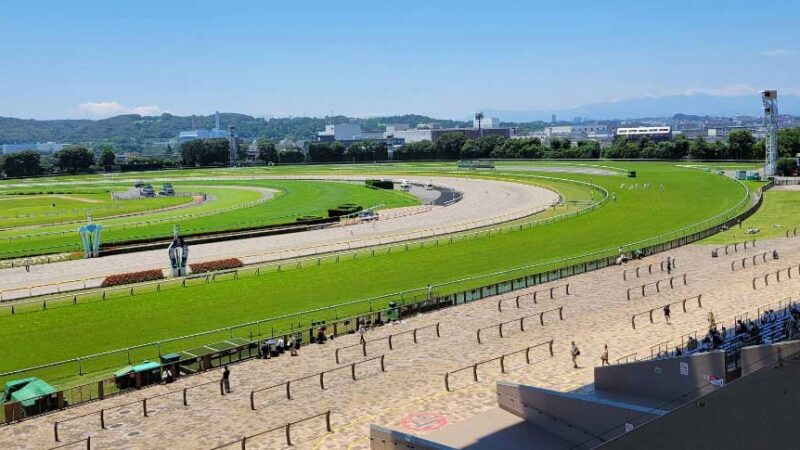
Tokyo Racecourse, located in Hiyoshi-cho, Fuchu City, Tokyo, is one of Japan’s largest racecourses. Operated by the JRA (Japan Racing Association), it is a central facility of Japanese horse racing, hosting numerous Grade I races including the Japan Derby.
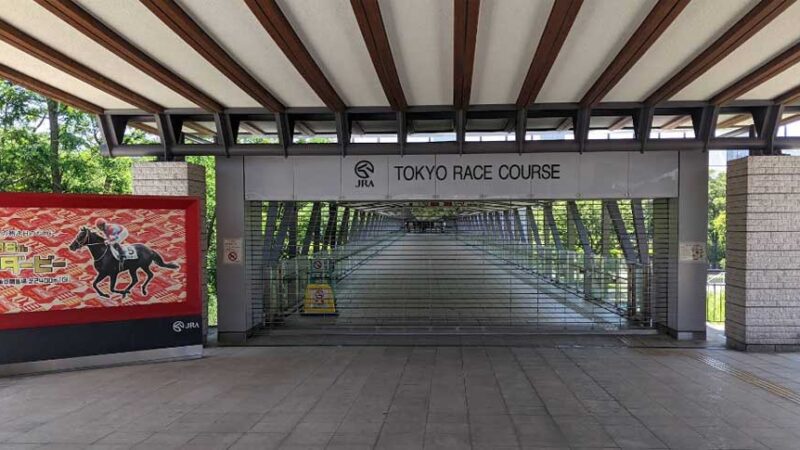
The main gate passage refers to the dedicated pedestrian overpass and passage that leads from Keio Line’s “Fuchu Racecourse Main Gate Station,” the nearest station, to the main gate of Tokyo Racecourse. The passage features a roofed structure, designed to allow comfortable access to the racecourse even in rainy weather.
Location and Access
Address: 1-1 Hiyoshi-cho, Fuchu City, Tokyo (Tokyo Racecourse)
Nearest Stations:
- Keio Line “Fuchu Racecourse Main Gate Station” 2 minutes walk (directly connected to main gate)
- Keio Line “Higashi-Fuchu Station” 10 minutes walk
- JR Musashino Line / Nambu Line “Fuchu Honcho Station” 15 minutes walk
When using the main gate passage, Fuchu Racecourse Main Gate Station offers the most convenient access. After exiting the ticket gate, heading left will quickly bring you to the entrance of the dedicated pedestrian overpass.
Business Hours and Entry
Tokyo Racecourse’s opening hours differ between race days and non-race days.
On Race Days:
- Normally 9:00 AM to around 5:00 PM (varies by race end time)
- Admission: 200 yen (free for those under 15)
On Non-Race Days:
- Normally 10:00 AM to 5:00 PM (varies by facility)
- Free admission (limited facilities available)
The main gate passage itself is a public passage connecting the station and racecourse, so it is generally accessible. However, race days are extremely crowded. For sacred site pilgrimage photography, non-race days or early morning hours are recommended.
Detailed Anime Appearance Scenes
Major Scenes from Season 1
Special Week’s First Appearance Scene (Episode 1)
In the memorable first episode of Season 1, the protagonist Special Week arrives from Hokkaido and visits Tokyo Racecourse for the first time. This scene uses the route from Higashi-Fuchu Station, with the path leading to the main gate passage depicted carefully.
Special Week’s figure, holding a large bag and heading to the racecourse with both hope and anxiety, has become a memorable scene for many fans.
Daily Training Scenes
The main gate passage appears across multiple episodes as the passage through which Uma Musume regularly move from the training center to the racecourse for training. Particularly in scenes where Special Week is jogging, the characteristic structure of the passage and surrounding scenery are finely reproduced.
Depictions in Season 2
In Season 2 “Uma Musume Pretty Derby Season 2,” while the protagonist changes to Tokai Teio, Tokyo Racecourse remains an important stage. The main gate passage similarly appears as a background element, forming an important part of the work’s worldview.
Comparison Between Anime and Actual Location
The anime production team conducted meticulous research of the actual Tokyo Racecourse, making the depiction of the main gate passage extremely faithful. The width of the passage, the roof structure, the layout of surrounding buildings—details down to the finest points faithfully recreate the actual scenery.
During sacred site pilgrimage, comparing anime screenshots with the actual scenery will let you appreciate the production team’s dedication.
Detailed Access from Fuchu Racecourse Main Gate Station
Overview of the Station
Fuchu Racecourse Main Gate Station is a Keio Line station where express trains stop only on race days, functioning as a special station. As its name suggests, it functions as the nearest station to Tokyo Racecourse’s main gate.
Station Characteristics:
- Very crowded on race days
- Only one ticket gate
- Relatively compact station interior
- Barrier-free (elevator equipped)
From Ticket Gate to Main Gate Passage Entrance
Upon exiting the ticket gate, directional signs to Tokyo Racecourse appear on the left. From the ticket gate to the main gate passage entrance is approximately 1 minute walk, about 50 meters.
Route:
- Turn left upon exiting the ticket gate
- Go straight through the station plaza
- Arrive at the dedicated pedestrian overpass entrance
To the left of the ticket gate exit stands the golden horse statue “Akhal-Teke Statue,” which also serves as a popular sacred site pilgrimage spot, with many fans taking commemorative photos.
Structure of the Main Gate Passage
The main gate passage is a roofed dedicated pedestrian overpass extending from the station area to Tokyo Racecourse’s main gate. Approximately 200 meters in total length, it has a width of about 5 meters.
Passage Characteristics:
- All-weather roofed structure
- Gentle slopes for easy walking
- Rest areas available midway
- One-way traffic control on race days
Both sides of the passage are transparent panels, allowing you to enjoy the surrounding scenery while walking. This distinctive structure is faithfully reproduced in the anime.
Route from Higashi-Fuchu Station (Special Week Route)
Why Higashi-Fuchu Station?
In Episode 1 of the anime, Special Week travels to Tokyo Racecourse on foot from Higashi-Fuchu Station rather than from Fuchu Racecourse Main Gate Station. This is considered a creative choice to depict Special Week, visiting Tokyo for the first time, finding her way while heading toward the racecourse.
Among fans, this route is called the “Special Week Route,” and sacred site pilgrimage following the same path as shown in the anime has become popular.
Route Details from Higashi-Fuchu Station to Main Gate Passage
Time Required: Approximately 10-15 minutes walk
Distance: Approximately 800 meters
Detailed Route:
- Exit Higashi-Fuchu Station’s north exit
- Go straight north along the road in front of the station
- Cross Fuchu Boulevard (Metropolitan Road 229)
- Pass through residential area heading toward racecourse
- Arrive near the main gate passage entrance
This route allows you to experience the path Special Week walked in the anime. Since it goes through a residential neighborhood, you can walk while feeling the anime atmosphere.
Photo Comparison Points with Anime Scenes
There are multiple points on the route from Higashi-Fuchu Station to the main gate passage that appeared in the anime.
Major Points:
- Higashi-Fuchu Station north exit stairs
- Station front shopping street
- Fuchu Boulevard pedestrian crossing
- Specific corner in the residential area
- Viewpoint where the racecourse comes into view
By bringing anime screenshots and comparing them with actual scenery as you walk, you can enjoy the sacred site pilgrimage more deeply.
Photography Spots and Recommended Angles
Main Gate Passage Entrance
The main gate passage entrance on the Fuchu Racecourse Main Gate Station side is the most popular photography spot. It appears multiple times in the anime, with memorable scenes of Uma Musume entering the passage.
Photography Points:
- Composition including entrance gates
- Angles utilizing the passage’s depth
- Perspective looking from station toward racecourse direction
On race days, there are many people and photography may be limited to the entrance only. Visiting on non-race days is recommended.
Inside the Passage
The interior of the main gate passage is also an important spot frequently featured in the anime. In particular, it is used as background in scenes where Special Week is jogging.
Recommended Angles:
- Photography from the center of the passage toward the racecourse
- Wide-angle photography including roof structure
- Scenery through transparent panels
- Composition utilizing the passage’s curves
The passage interior is relatively spacious, so be mindful of other pedestrians while photographing.
Main Gate Arrival Point
The area in front of Tokyo Racecourse’s main gate at the end of the main gate passage is also an important photography spot. In the anime, it is depicted as background when Uma Musume arrive at the racecourse.
Photography Tips:
- Photograph the gate entrance straight-on
- Angle looking at the main gate from the passage
- Composition including the entire plaza in front of the main gate
On race days, the entrance gate functions as the entry point, making photography difficult. On non-race days, you can photograph leisurely.
Nearby Sacred Site Spots
Multiple sacred site pilgrimage spots are scattered around the main gate passage.
Akhal-Teke Statue:
A golden horse statue to the left upon exiting the ticket gate of Fuchu Racecourse Main Gate Station. It appears in the anime and is a standard commemorative photo spot.
Station Plaza:
A plaza that becomes busy with many fans on race days. It also appears as background in the anime.
Racecourse Perimeter:
The area around Tokyo Racecourse’s perimeter is depicted as a place where Uma Musume train.
Best Timing for Visits
Differences Between Race Days and Non-Race Days
Visiting Tokyo Racecourse presents very different circumstances on race days versus non-race days. It is important to select the appropriate day according to your sacred site pilgrimage purpose.
Race Days:
- Advantages: Can view inside the racecourse, can experience the anime atmosphere
- Disadvantages: Extremely crowded, photo-taking difficult, admission required
Non-Race Days:
- Advantages: Less crowded, easier to photograph, can enjoy at leisure
- Disadvantages: Only partial access to racecourse facilities, cannot experience race atmosphere
Time of Day Recommendations
Early Morning (7:00-9:00 AM):
The least crowded time, ideal for photography. The main gate passage bathed in morning sun is perfect for recreating anime morning scenes. However, be mindful of station operating hours on non-race days.
Morning (9:00 AM-12:00 PM):
Relatively quiet and easy to photograph. With good weather, you can take advantage of natural light.
Afternoon (12:00-3:00 PM):
The most crowded time on race days. On non-race days, you can photograph in bright midday light.
Evening (3:00-5:00 PM):
The main gate passage illuminated by sunset is ideal for recreating evening scenes from the anime. Race days experience homebound rush crowds.
Seasonal Differences
Spring (March-May):
Major races like the Japan Derby (May) are held. During cherry blossom season, surrounding scenery is beautiful and ideal for photography.
Summer (June-August):
Tokyo Racecourse has a summer closure period, making non-race days more frequent. This is the ideal season for sacred site pilgrimage.
Autumn (September-November):
The autumn Grade I racing season with many important races. During autumn foliage season, you can enjoy the surrounding scenery.
Winter (December-February):
Year-end major races like the Arima Memorial (December) are held. Winter has clear air, making it an ideal period for photography.
Sacred Site Pilgrimage Notes and Etiquette
Photography Etiquette
When taking photos during sacred site pilgrimage, observe the following etiquette.
Basic Etiquette:
- Be considerate of foot traffic
- Avoid lengthy occupancy of spaces
- Be mindful that other people don’t appear in shots
- Avoid using tripods during crowded times
- Don’t speak loudly
Precautions on Race Days:
- Avoid photographing near the entrance gates
- Don’t obstruct pedestrian flow
- Follow staff instructions
- Don’t get in the way of people in a hurry
Facility Usage Rules
Tokyo Racecourse and the main gate passage are public facilities. Observe the following rules.
Prohibited Activities:
- Smoking is prohibited outside designated areas
- Littering prohibited
- Entry to off-limits areas prohibited
- Damaging or defacing facilities prohibited
- Commercial photography requires permission
Recommended Practices:
- Take your trash with you
- Practice spirit of consideration
- Remember consideration for local residents
- Act quietly
Consideration for Neighboring Residents
The Tokyo Racecourse area includes many residential zones, and it is the living area of local residents. When visiting for sacred site pilgrimage, note the following:
Consideration Points:
- Keep voices down in residential areas
- Do not enter private property
- Be mindful of noise during late night/early morning
- Never park along streets
- Respect local rules
Sacred site pilgrimage succeeds through community understanding and cooperation. Observe etiquette and help maintain these spaces as beloved sacred sites long-term.
Points of Interest Inside the Racecourse
Entering the Racecourse
The interior of Tokyo Racecourse, beyond the main gate passage, is also an important stage in “Uma Musume Pretty Derby.” On race days, you can enter by paying admission (200 yen).
Entry Notes:
- Free for those under 15 (parental accompaniment recommended)
- Re-entry same day is possible (stamp required)
- Baggage inspection may occur
- Dangerous items prohibited
Anime Appearance Spots (Inside Racecourse)
The racecourse interior contains numerous spots that appeared in the anime.
Main Spots:
- Winners Circle: Where victory ceremonies are held after races. Appears in anime victory scenes.
- Paddock: Where Uma Musume appear before races. Used in important anime scenes.
- Turf Vision: Large screen. Appears in anime backgrounds.
- Stands: Spectator seating. Depicted in anime scenes with spectator cheers.
- Track (Course): Where actual races are held. The stage for anime race scenes.
Non-Race Day Activities
Some Tokyo Racecourse facilities are available even on non-race days.
Available Facilities:
- Fuji View Stand (observation facility)
- Museum of Horse (adjacent facility)
- Park area
- Some dining establishments
Non-race days are quiet, allowing leisurely sacred site pilgrimage. You can compare anime scenes with actual locations while immersing yourself in the work’s worldview.
Nearby Sacred Site Pilgrimage Spots
Sacred Sites in the Fuchu Area
The area around Tokyo Racecourse contains multiple sacred sites related to “Uma Musume Pretty Derby.”
Major Spots:
- Area around Fuchu Honcho Station: Streetscapes appearing in anime
- Fuchu no Mori Park: Background in training scenes
- Tamagawa Riverbed: Appears in jogging scenes
- Fuchu City Streets: Backgrounds in daily scenes
Visiting these spots allows you to experience the anime world more deeply.
Efficient Pilgrimage Route
We introduce an efficient route visiting sacred sites centered on Tokyo Racecourse main gate passage.
Half-Day Course (3-4 hours):
- Higashi-Fuchu Station (Special Week Route start)
- Main gate passage
- Tokyo Racecourse main gate
- Akhal-Teke Statue
- Fuchu Racecourse Main Gate Station
Full-Day Course (6-8 hours):
- Higashi-Fuchu Station
- Fuchu city streets
- Main gate passage
- Tokyo Racecourse interior (if race day)
- Nearby parks and riverbed
- Fuchu Honcho Station
If time permits, enjoying a leisurely pilgrimage while resting at nearby restaurants is also recommended.
Combining with Actual Horse Race Viewing
Appeal of Horse Race Viewing
For “Uma Musume Pretty Derby” fans, watching actual horse races is a valuable experience that deepens understanding of the work. You can experience the thrills and excitement of races depicted in the anime at an actual racecourse.
Ways to Enjoy Horse Race Viewing:
- Experience the thrill of actual racing
- See horses up close at the paddock
- Experience the racecourse atmosphere
- Compare with anime scenes
Viewing Guide for Beginners
We introduce points for those viewing horse races for the first time.
Viewing Basics:
- Enjoy a full day for 200 yen admission
- Can view without purchasing tickets
- Understand the paddock→main track entrance→race flow beforehand
- Check race times in advance
Recommended Races:
- Japan Derby (May): Important race in anime
- Tokyo Yushun (Japan Derby): Deciding 3-year-old supremacy
- Emperor’s Cup (Spring/Autumn): Historic Grade I races
- Japan Cup (November): International big races
Uma Musume Fan Events
Tokyo Racecourse occasionally hosts collaboration events with “Uma Musume Pretty Derby.”
Past Event Examples:
- Character panel displays
- Voice actor talk shows
- Original merchandise sales
- Stamp rallies
- Photo spots
Check official sites and SNS for the latest information and consider visiting on event dates.
Photography Equipment and Techniques
Recommended Photography Equipment
The following equipment is useful for sacred site pilgrimage photography.
Basic Equipment:
- Smartphone: Convenient and high-quality photography
- Digital camera: For higher quality photos
- Spare battery: For extended photography sessions
Helpful Additional Equipment:
- Small tripod: For stable photography (avoid on crowded times)
- Wide-angle lens: Effective for photographing the entire passage
- Tablet: Reference anime screenshots while photographing
Photography Techniques
We introduce techniques for recreating anime scenes in photographs.
Angle Matching:
- Prepare anime screenshots
- Photograph from same position and height
- Match angles
- Consider time of day and weather
Composition Points:
- Utilize passage depth
- Include roof structure
- Be mindful of spatial relationships with surrounding buildings
- If including people, rear view is recommended
Light Usage:
- Utilize natural light
- Avoid backlighting
- Cloudy days offer soft light for easier photography
- Use afternoon slant light for atmospheric shooting
Sacred Site Pilgrimage Reports on SNS
Hashtag Usage
When sharing sacred site pilgrimage photos on SNS, use appropriate hashtags.
Recommended Hashtags:
- #ウマ娘
- #ウマ娘聖地巡礼
- #東京競馬場
- #アニメ聖地巡礼
- #聖地巡礼
- #プリティーダービー
- #府中競馬正門前駅
Using these hashtags allows you to connect with fans with similar interests.
Posting Precautions
Privacy Considerations:
- Be mindful that other people’s faces don’t appear in photos
- Pixelate personal information (address displays, etc.)
- Don’t photograph others without permission
Copyright Considerations:
- Use anime screenshots within fair use limits
- Specify comparative purpose
- Avoid excessive reposting
Community Interaction
Sacred site pilgrimage reports on SNS become opportunities for community interaction.
Interaction Points:
- Like and comment on other fans’ posts
- Share photography tips and favorite spots
- Plan meetups and joint pilgrimages
- Exchange information about etiquette and precautions
Share information between fans and foster a better sacred site pilgrimage culture.
Conclusion: The Appeal of Tokyo Racecourse Main Gate Passage
Tokyo Racecourse’s main gate passage is an important sacred site spot where you can experience the worldview of “Uma Musume Pretty Derby.” This passage connecting Fuchu Racecourse Main Gate Station to the racecourse has appeared in numerous memorable scenes in the anime and has become a special place for fans.
Appeal of the Main Gate Passage:
- Real location faithfully reproduced in anime
- Path walked by Special Week and other Uma Musume
- Easy access directly connected to station
- Comfortable shooting with roof cover
- Numerous nearby sacred site spots
When conducting sacred site pilgrimage, remember to follow etiquette and be considerate of residents and other users. Understanding the appeal of both race days and non-race days and visiting at a time suitable for you is recommended.
Combining with actual horse race viewing will allow you to more deeply understand the horse racing world depicted in the anime. Using Tokyo Racecourse main gate passage as a starting point and visiting various sacred sites in the Fuchu area, fully enjoy the world of “Uma Musume Pretty Derby.”
The experience gained from visiting actual locations while holding the emotion of the anime in your heart will surely become a precious memory for fans. We hope this article aids your sacred site pilgrimage.