Introduction: The Deep Relationship Between Uma Musume and Tokyo Racecourse
“Uma Musume Pretty Derby” is an anime and game work set at real racecourses, and among them, Tokyo Racecourse located in Fuchu, Tokyo is one of the most important sacred sites. In particular, the Fuji View Stand (Racecourse side) has become a special place among fans as the stage where many Uma Musume, including Special Week, have competed in intense races since appearing in the first episode of the anime.
This article provides a thorough explanation of Tokyo Racecourse’s Fuji View Stand (Racecourse side) from every angle, including its relevance to the anime, practical methods for pilgrimage to sacred sites, shooting points, and the appeal of the racecourse itself.
Uma Musume Pretty Derby: Overview
Overview of the Work and Its World
“Uma Musume Pretty Derby” is a story about “Uma Musume” (beautiful girls who are real racehorses reimagined) competing in races called the Twinkle Series. The television anime’s first season aired in 2018, followed by “Season 2” in 2021 and “Season 3” in 2023. Additionally, a smartphone game app also became a massive hit, making it a work supported by audiences beyond just horse racing fans.
A major characteristic of the work is that it faithfully recreates real racecourses and the historical facts of actual racehorses. Important races held at Tokyo Racecourse, such as the Japan Derby, the Emperor’s Cup (Autumn), and the Japan Cup, serve as important stages in the story, with the actual racecourse scenery depicted faithfully.
Why Tokyo Racecourse Is an Important Stage
Tokyo Racecourse is positioned as the largest among the racecourses operated by the Japan Racing Association (JRA) and is regarded as the center of Japanese horse racing. The following important races appear as stages in the story:
- Japan Derby (Tokyo Yusho): The supreme race that determines the champion of three-year-old horses
- Emperor’s Cup (Autumn): The old horse middle-distance champion decisive battle
- Japan Cup: An international invitational race where top horses from around the world compete
- Yasuda Kinen: The mile king decisive battle
- Victoria Mile: The filly mile king decisive battle
In anime episode 1, “Through the Dream Gate!”, the main character Special Week visits Tokyo Racecourse for the first time, and the scene where she is overwhelmed by its scale is depicted impressively. The Fuji View Stand (Racecourse side) is precisely what appears in this scene.
Basic Information About Tokyo Racecourse’s Fuji View Stand
Structure and Characteristics of the Fuji View Stand
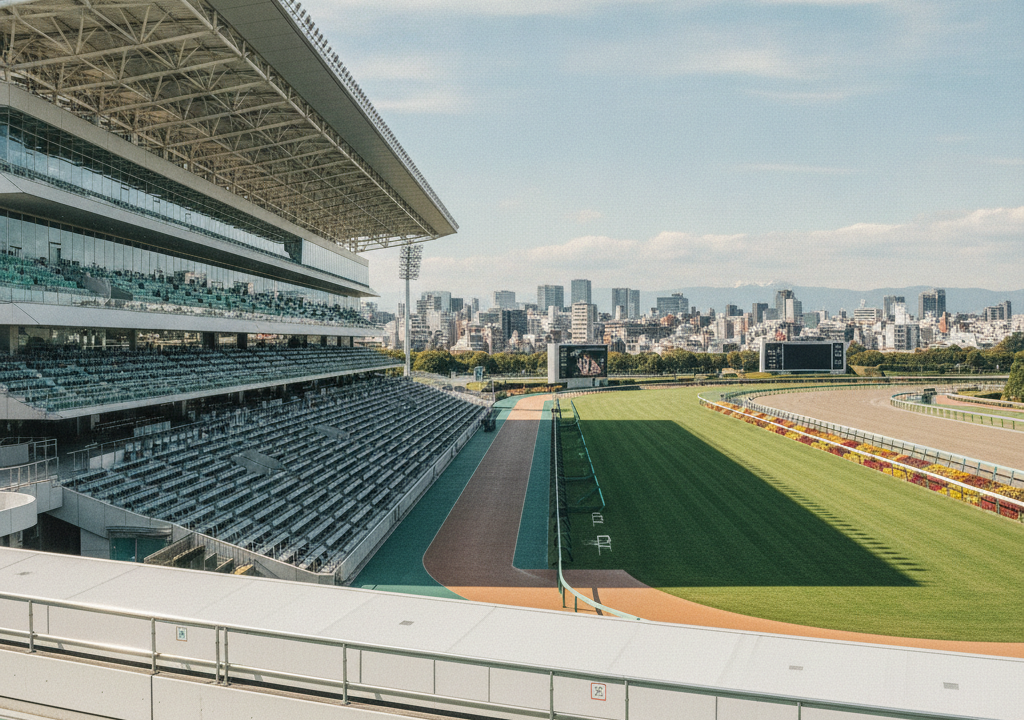
The Fuji View Stand is the main stand of Tokyo Racecourse, and its name derives from the fact that on clear days one can see Mount Fuji. This massive structure has 9 stories above ground and 1 basement level and is known as one of the world’s largest racecourse stands.
Architectural Features:
- Total length: Approximately 580 meters
- Capacity: Approximately 223,000 people (entire racecourse)
- Completion year: 2007 (major renovation)
- Design concept: Prioritizing viewer visibility and comfort
The stand is broadly divided into the “Racecourse side” and the “Infield side,” with the “Racecourse side” being crucial for Uma Musume sacred site pilgrimages. From the racecourse side, one can see the entire racing course and experience the excitement near the finish line up close.
What Is the Racecourse Side?
The “Racecourse side” refers to the side of the Fuji View Stand facing the course (track). A racecourse generally has the following structure:
“`
[Infield Area (Park, etc.)] ← Infield side
[Racing Course (Turf/Dirt)]
[Fuji View Stand] ← Racecourse side (viewing from this side)
[Paddock/Parade Ring]
“`
Each floor on the racecourse side has the following facilities:
Floors 1-3:
- General seating (unreserved)
- Reserved seating areas
- Restaurants and shops
- Betting ticket windows
Floors 4-5:
- Green sheet (designated paid seating)
- Royal boxes
- Restaurants
Floors 6-9:
- Special viewing seats
- VIP rooms
- Observation decks
Most scenes appearing in the anime use compositions photographed from the general viewing areas on floors 2-3.
History and Renovations of the Facilities
Tokyo Racecourse has a long history, opening in 1933 (Showa 8). Initially it had wooden stands, but after post-war reconstruction, a reinforced concrete stand was completed in 1975.
The current Fuji View Stand was completed in 2007 as the latest facility, with the following renovations implemented:
- Complete barrier-free accessibility
- Installation of large displays (Turf Vision)
- Air conditioning facilities
- Enhanced dining facilities
- Increased multipurpose restrooms
Through these renovations, the “leisure facility” aspect has been strengthened, allowing not just horse racing fans but also families and couples to spend time comfortably. For Uma Musume fans, it’s an environment where you can enjoy sacred site pilgrimages, horse racing viewing, and leisure simultaneously.
Detailed Explanation of Appearance Scenes in Anime and Games
Important Scenes from Anime Season 1
Episode 1 “Dream Gate!”
The scene where Special Week comes from the countryside to Tokyo and visits Tokyo Racecourse for the first time is an emblematic moment in the Uma Musume work. The Fuji View Stand’s massive scale and the vast expanse of the racecourse are depicted impressively, showing Special Week’s overwhelmed expression.
Specific appearance cuts:
- Full exterior view of Fuji View Stand (from near the west gate)
- Angle overlooking the course from floor 2 of the stand
- Composition showing the finish line and Turf Vision
- Staircase section of the audience seating
Episode 3 “My First Big Race!”
Tokyo Racecourse appears as the stage for the Yayoi Sho. The paddock before the race, the starting point, and the intense competition at the finish line are depicted. The scene of cheers from the Fuji View Stand echoing across the racecourse vividly recreates the real atmosphere of a racecourse.
Episode 13 “To the Dream Stage!”
The climax of the Japan Derby. Special Week and Seuin Sky’s fierce deadheat unfolds. The scene of spectators in the Fuji View Stand watching as they dash past the finish line is the pinnacle of anime Season 1.
Appearances in Anime Season 2 and 3
In anime Season 2, “Season 2,” Tokai Teio becomes the protagonist, with the Emperor’s Cup (Autumn) at Tokyo Racecourse and the Arima Memorial (at Nakayama Racecourse) becoming important stages. The Fuji View Stand appears throughout Season 2, with particularly impressive depictions of the audience seats witnessing Teio’s comeback.
In anime Season 3, with Kitasan Black as the protagonist, Tokyo Racecourse once again becomes an important stage.
Reproduction Accuracy in the Game Version
In the smartphone game “Uma Musume Pretty Derby,” racing scenes at Tokyo Racecourse are reproduced in 3D graphics. The following points are particularly highly evaluated:
- Accurate reproduction of course layout
- Design of Fuji View Stand exterior
- Placement of Turf Vision
- Realism of spectator cheers and announcements
The game features “Tokyo Racecourse” where the following races are held:
Spring Season:
- Satsuki Sho (first leg of Classic Triple Crown)
- NHK Mile Cup
- Victoria Mile
- Tokyo Yusho (Japan Derby)
Fall Season:
- Emperor’s Cup (Autumn)
- Yasuda Kinen
- Japan Cup
Visiting actual Tokyo Racecourse after seeing in-game racing footage reveals the impressive accuracy of the reproduction.
Practical Guide to Sacred Site Pilgrimage
Detailed Access Information
Access to Tokyo Racecourse is generally by train.
Using the Keio Line (Most Recommended)
- Fuchu Keiba Seimon-mae Station: The closest station to Tokyo Racecourse
- About 25 minutes by express from Shinjuku Station
- 2-minute walk to the main gate from the station
- Limited express stops at this station on racing days
- Higashi-Fuchu Station: Convenient for accessing the west gate
- About 23 minutes by express from Shinjuku Station
- 10-minute walk to the west gate from the station
- Relatively uncrowded route
Using JR Lines
- Fuchu Honmachi Station (JR Nambu Line/Musashino Line)
- 15-minute walk to the main gate from the station
- Alternative route when Keio Line is crowded
By Car
On racing days, dedicated parking is available but very crowded.
- About 10 minutes from “Chofu IC” on the Chuo Expressway
- Parking fee: 1,000 yen for regular vehicles (on racing days)
- Capacity: Approximately 3,000 vehicles
By Bus
- About 10 minutes by bus from Fuchu Station (Keio Line)
- About 15 minutes by bus from Warigehara Station
Admission Methods and Fees
On Racing Days
- Admission fee: 200 yen (free for ages under 15)
- Opening time: Typically 9:00-9:30 (varies by race)
- Closing time: 30 minutes after the final race
On Non-Racing Days
Tokyo Racecourse is open to the public as “Tokyo Racecourse Park” on non-racing days.
- Admission fee: Free
- Operating hours: 10:00-17:00 (varies by season)
- Closed: Mondays (or the following day if Monday is a holiday)
For sacred site pilgrimage purposes, non-racing days are recommended since you can photograph more peacefully. However, if you want to experience the excitement of racing, visit on a racing day.
How to Get to Fuji View Stand (Racecourse Side)
Movement flow after entering through the main gate:
- The Fuji View Stand is visible immediately upon entering the main gate
- Pass through the floor 1 entrance hall
- Take escalator or stairs to floor 2
- Floor 2 “Turf Side” is the general viewing area
- Proceed to the racecourse-side seating area
When entering through the west gate:
- Enter toward the west side of the stand
- Enter the stand and move toward the east side
- Proceed to the viewing area on floor 2 or 3
Photography Points and Angle Recreation
For sacred site pilgrimage, accurately recreating scenes from the anime is important. Below are the main shooting points:
Point 1: Stand Exterior (Near West Gate)
This matches the composition from anime episode 1 where Special Week looks up at Tokyo Racecourse for the first time.
- Shooting location: Plaza just inside the west gate
- Time of day: Morning is recommended to avoid backlighting
- Recommended lens: Wide-angle (24mm or less)
Point 2: Racecourse Overview from Floor 2 Viewing Seats
This is the most frequently appearing angle.
- Shooting location: Center area of floor 2 Turf Side
- Fit the finish line and Turf Vision in the frame
- On clear days, Mount Fuji is also visible (winter recommended)
Point 3: Staircase Section
The stairs appear in scenes where characters move.
- Shooting location: Stairs between floor 2 and 3
- Aim for times when there are fewer people
Point 4: Near the Finish Line
The finish line always appears in racing climax scenes.
- Shooting location: Finish line front area on floor 2 of the stand
- Secure a spot early as it gets crowded with spectators on racing days
Photography Precautions
- Tripod use: Often prohibited on racing days
- Consideration for other visitors: Avoid extended spot-holding
- Photography during races: Flash photography is strictly prohibited
- Follow staff instructions: Comply with directions from security and staff
- SNS posting: Be considerate when other visitors appear in photos
Recommended Visiting Periods and Timing
For Sacred Site Pilgrimage Focus
- Weekday non-racing days: Least crowded and easiest to photograph
- Spring/autumn clear days: Higher probability of seeing Mount Fuji
- Morning: Best lighting conditions
To Enjoy Horse Racing Viewing Too
- Japan Derby (last Sunday in May): Many Uma Musume fans gather
- Japan Cup (last Sunday in November): International big race
- Emperor’s Cup Autumn (last Sunday in October): Championship of old horses
These big race days often feature collaboration events with Uma Musume.
The Appeal of Tokyo Racecourse: Its Aspect as a Racing Venue
History as the Center of Japanese Horse Racing
Tokyo Racecourse is closely connected to the history of Japanese horse racing. Since its opening in 1933, numerous legendary matches have taken place.
Historically Significant Races:
- 1984: Symbolirudolf achieves undefeated Triple Crown (Satsuki Sho, Derby)
- 1993: Biwa Hayahide vs. Narita Taishin in the Emperor’s Cup (Autumn)
- 2005: Deep Impact’s undefeated Triple Crown (Satsuki Sho, Derby)
- 2011: Orfevre achieves Triple Crown (Satsuki Sho, Derby)
These legendary horses appear as Uma Musume, and their glorious stage is Tokyo Racecourse.
Course Characteristics and Strategy
Tokyo Racecourse’s most distinctive feature is its “flat terrain with a long straightaway.”
Course Details:
- Turf course: 2,083 meters per lap
- Straightaway: 525.9 meters (Japan’s longest)
- Elevation change: 2.7 meters (extremely flat)
- Course width: Maximum 35 meters
Course Strategy Points:
- Late kick ability is important for utilizing the long straightaway
- The flat terrain often results in endurance competitions
- While inside positions are favored, actual ability is well reflected
In the game “Uma Musume,” runners with “chasing” and “closing” running styles are set to excel at Tokyo Racecourse.
Annual Major Race Schedule
Many stakes races are held at Tokyo Racecourse throughout the year.
Spring Season (April-June)
| Race Name | Timing | Distance | Grade |
|———–|——–|———-|——-|
| Satsuki Sho | Mid-April | Turf 2000m | GI |
| NHK Mile Cup | Early May | Turf 1600m | GI |
| Victoria Mile | Mid-May | Turf 1600m | GI |
| Tokyo Yusho (Japan Derby) | Last Sunday in May | Turf 2400m | GI |
| Yasuda Kinen | Early June | Turf 1600m | GI |
Fall Season (October-November)
| Race Name | Timing | Distance | Grade |
|———–|——–|———-|——-|
| Emperor’s Cup (Autumn) | Last Sunday in October | Turf 2000m | GI |
| Japan Cup | Last Sunday in November | Turf 2400m | GI |
| Elizabeth Queen Cup | Mid-November | Turf 2200m | GI |
All these races are reproduced in the Uma Musume game as well, and observing actual races deepens understanding of the game.
Sacred Site Pilgrimage Spots in the Surrounding Area
Several other Uma Musume-related sacred sites are scattered around Tokyo Racecourse.
Fuchu-no-Mori Park
A model for park scenes appearing in the anime.
- Location: 1-chome Asamacho, Fuchu, Tokyo
- 15-minute walk from Tokyo Racecourse
- Spacious lawn area and forest sections
- Setting for scenes where characters practice
Okunotama Shrine
A historic shrine located at the center of Fuchu, appearing in anime Season 1 episode 2.
- Location: 3-1 Miyamacho, Fuchu, Tokyo
- 5-minute walk from Fuchu Station
- Ancient shrine founded over 1,900 years ago
- Visited by people in the racing industry for prayers
Area Around Fuchu Station
The streets around Keio Line Fuchu Station also appear in the anime.
- Station plaza
- Shopping streets
- Keyaki-lined boulevard
Visiting these spots makes for a more fulfilling sacred site pilgrimage.
Experience Reports from Fans Who Actually Visited
First Sacred Site Pilgrimage Report
Many Uma Musume fans have visited Tokyo Racecourse and shared their impressions on SNS.
A’s (Female, 20s) Experience:
“I was moved to see the scenery from the anime spread out before my eyes. Especially the view from floor 2 of the Fuji View Stand was exactly what Special Week saw, and I nearly cried. Since I visited on a non-racing day, I was able to photograph at leisure.”
B’s (Male, 30s) Experience:
“I visited on Japan Derby day. Many fans were in Uma Musume cosplay, and the entire racecourse had a festive atmosphere. Seeing an actual race, I realized how faithfully the anime recreated the racing scenes.”
Combining Race Viewing and Sacred Site Pilgrimage
If visiting on a racing day, you can combine race viewing and sacred site pilgrimage.
Recommended Way to Spend Your Time:
- Morning: Photography during relatively quiet hours
- Noon: View horses in the paddock
- Afternoon: Watch main races
- After races: Photography or facility visits again
The racecourse has numerous dining options and offers all-day enjoyment.
Horse Racing Introduction for Uma Musume Fans
Basic Knowledge of Betting
Basic knowledge for Uma Musume fans to enjoy actual horse racing is introduced.
Types of Bets:
- Win: Betting on a horse to finish first (simplest)
- Place: Betting on a horse to finish in the top 3 (easiest to win)
- Quinella: Selecting the 1st and 2nd place horses (any order)
- Exacta: Selecting 1st and 2nd place horses in order
- Trifecta: Selecting 1st-3rd place horses (any order)
- Superfecta: Selecting 1st-3rd place horses in exact order (highest payout)
Beginners are recommended to start with “Place” bets.
Correspondence Between Uma Musume and Real Horses
Many Uma Musume appearing in games and anime are modeled after real champion horses.
Major Characters and Model Horses:
- Special Week → Special Week (1998 Derby horse)
- Silence Suzuka → Silence Suzuka (1998 Emperor’s Cup Autumn)
- Tokai Teio → Tokai Teio (1991 Derby horse)
- Oguri Cap → Oguri Cap (1990 Arima Memorial)
- Deep Impact → Deep Impact (2005 undefeated Triple Crown horse)
Researching real horses’ records before viewing races allows for deeper enjoyment.
Race Viewing Manners and Rules
Racecourses have unique manners and rules.
Basic Manners:
- Loud cheering during races is OK (part of racing culture)
- Entry and viewing are possible even without buying betting tickets
- Photography is generally free (flash prohibited)
- Unreserved seats allow free movement
- Dispose of trash properly or at designated locations
Prohibited:
- Abusive language toward horses or jockeys
- Dangerous cheering actions
- Blocking thoroughfares
- Smoking outside designated areas
Other Pleasures of Tokyo Racecourse: Attractions Beyond Racing
JRA Racing Museum
A horse racing specialty museum located within the Fuji View Stand.
- Admission: Free
- Operating hours: 10:00-16:00 (until 17:00 on racing days)
- Exhibits: Horse racing history, introduction of famous horses, Jockey Hall of Fame, etc.
The museum displays materials about the famous horses that served as models for Uma Musume, making it a must-see spot for fans.
Facilities in the Infield Area
Various leisure facilities are available in the infield area (inside the course) of Tokyo Racecourse.
Main Facilities:
- Pony Riding Corner: Horse riding experience for children
- Water Play Area: Summer-limited water play space
- Mini Shinkansen: Popular attraction for children
- Lawn Area: Perfect for picnicking
- Bouncy Dome: Play equipment for children
A family-friendly environment where families can enjoy a full day.
Dining and Shopping
The racecourse has diverse dining options.
Recommended Cuisine:
- Turfie Cafe: Original racecourse menus
- Fujimi Cafeteria: Full selection of set meals and noodles
- Food Trucks: Multiple options on racing days
- Stand Cafes: Light snacks and drinks
“Turfie Cafe” in particular is popular with Uma Musume fans, offering menus themed after the racecourse’s mascot character “Turfie.”
Official Shop:
- JRA official goods
- Racecourse-limited products
- Uma Musume collaboration goods (during events)
Uma Musume × Tokyo Racecourse Collaboration Event Information
Past Collaboration Results
Tokyo Racecourse and Uma Musume have held multiple collaboration events.
Main Collaboration Content:
- Life-size panel installations
- Original merchandise sales
- Voice actor talk shows
- Stamp rallies
- Collaborative menu items
Large-scale collaborations are particularly likely during big races like the Japan Derby or Japan Cup on their respective racing days.
Future Event Predictions
With the continued popularity of Uma Musume, the following events are predicted:
- Collaborations coinciding with new anime season broadcasts
- Projects coordinated with in-game events
- New character release commemorative events
Latest information is continuously announced on the JRA official site and Uma Musume official site.
Tips for Maximizing Your Sacred Site Pilgrimage
Pre-visit Checklist
What to Bring:
- Camera/smartphone (fully charged)
- Mobile battery
- Screenshots of relevant anime scenes
- IC transportation card
- Hat/sunscreen (summer)
- Warm clothing (winter)
Things to Confirm in Advance:
- Horse racing schedule (JRA official site)
- Weather forecast (especially important if you want to see Mount Fuji)
- Nearest station schedules
- Racecourse opening and closing times
SNS Usage
Information gathering and sharing on SNS is also part of sacred site pilgrimage enjoyment.
Recommended Hashtags:
- #ウマ娘
- #ウマ娘聖地巡礼
- #東京競馬場
- #フジビュースタンド
- #ウマ娘プリティーダービー
Searching these hashtags reveals other fans’ visit reports and photography tips.
Enjoyable Solo, Even Better With Friends
Sacred site pilgrimage is enjoyable solo, but even more so with like-minded companions.
Solo Pilgrimage Advantages:
- Travel at your own pace
- Focus on photography
- Enjoy interactions with other visitors
Group Pilgrimage Advantages:
- Take turns with photography
- Share the emotion
- Safer overall
Either style allows Tokyo Racecourse to be fully enjoyed.
Frequently Asked Questions (FAQ)
Can I enjoy it without horse racing knowledge?
Yes, absolutely no problem. Tokyo Racecourse is developed as a comprehensive leisure facility enjoyable by non-racing fans. As a Uma Musume fan, you can sufficiently enjoy it with only knowledge gained from anime or games. In fact, many fans discover the appeal of horse racing through sacred site pilgrimages.
Can I photograph freely?
Photography is generally free within personal use scope. However, note the following:
- Tripod use is restricted on racing days
- Be considerate of other visitors’ privacy
- Flash photography is prohibited to avoid startling horses
- Commercial use requires advance permission
Can I enter Fuji View Stand on non-racing days?
Yes, you can. Tokyo Racecourse is open as “Tokyo Racecourse Park” on non-racing days, and some areas of the Fuji View Stand are open to the public. However, accessible areas may be limited compared to racing days. For sacred site pilgrimage purposes, non-racing days are recommended for peaceful photography.
How much time do I need?
It depends on your purpose:
- Sacred site pilgrimage only: 2-3 hours
- Including race viewing: 4-6 hours
- Including surrounding spots: Full day
For first-time visitors, planning for a half-day is recommended.
Is it okay to bring children?
Yes, Tokyo Racecourse is family-friendly.
- Nursing rooms and diaper changing facilities
- Stroller rentals available
- Extensive children’s play equipment
- Restaurants with kids’ menus
It actively welcomes families and is comfortable.
Is Uma Musume cosplay allowed?
Excessive cosplay at racecourses is not recommended, but cosplay within reasonable limits poses no problem. In fact, fans wearing Uma Musume ears or tails are seen on big race days. Note the following:
- Stay within limits that don’t inconvenience other visitors
- No changing rooms, so wear from home or use simple accessories
- Official collaboration events may have special rules
Summary: Experiencing the Uma Musume World at Tokyo Racecourse
Tokyo Racecourse’s Fuji View Stand (Racecourse side) is the sacred site where you can most vividly experience the “Uma Musume Pretty Derby” world. The emotion of seeing in real life the scenery from the anime becomes an irreplaceable experience for fans.
Beyond mere sacred site pilgrimage, Tokyo Racecourse offers diverse ways to enjoy itself, including actual race viewing, learning at the racing museum, and touring surrounding spots. The charm of Tokyo Racecourse lies in these multiple dimensions. Uma Musume may be your entry point into the profound world of horse racing, expanding into a new hobby.
Please definitely visit Tokyo Racecourse and see with your own eyes that stage where Special Week and the others galloped. The view from Fuji View Stand will surely deepen your love for Uma Musume further.
On racing days, experience the intensity of actual races; on non-racing days, enjoy leisurely pilgrimage. Either way, Tokyo Racecourse welcomes you warmly. Now, as a trainer and as a fan, let your “entry” to Tokyo Racecourse begin!